28 Hairstyles for Fine Thin Hair and How to Choose the Right One
Fine hair and low-density hair get treated as the same thing, but they’re not. Fine describes the diameter of each individual strand, narrower strands can feel softer and lose shape more easily. Low density describes how many strands you actually have per square inch of scalp. You can have fine strands with average or even high density, or coarser strands that are simply fewer in number, and the two situations don’t always call for the same haircut.
What reads as “fuller” hair on any given day usually comes from several things working together: how much weight is left at the perimeter, where layers are placed, the cut’s length, your natural texture, how you style it, where you part it, and how your crown and hairline compare in density to the rest of your scalp. The 28 ideas below cover haircuts, styling techniques, and one chemical treatment, each addressing a different piece of that picture.
Blunt Bob with Subtle Layers

An unbroken, blunt perimeter gives the eye a solid line to read, which is part of why this shape is often suggested when the goal is making the ends look more substantial. That’s a visual effect of the cutting technique, not a change in how much hair you actually have. A few subtle interior layers add some movement without disturbing that line. The trade-off is grow-out: a blunt hem shows lengthening more visibly than a layered one, so it generally needs more frequent trims to stay looking crisp.
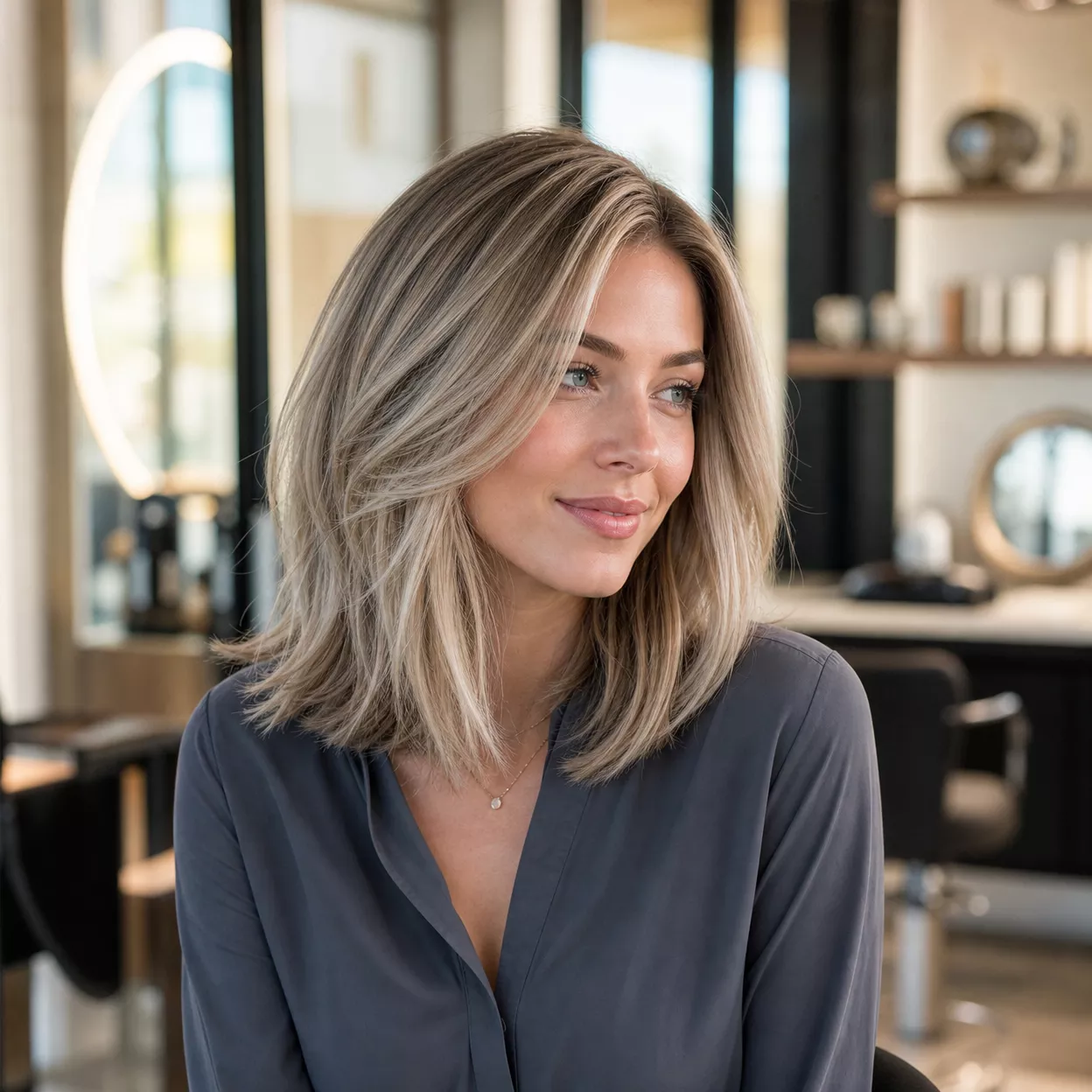
Feathered Shoulder Length Cut

Feathering tapers the ends rather than cutting them straight across, which can bring out more visible movement through the lengths. How well this works depends on density as much as strand width: fine, dense hair usually holds feathered ends without looking thin, while fine hair that’s also low in density can end up with sparser-looking ends if too much weight comes out. Starting conservative and adjusting at a follow-up visit is a reasonable approach if you’re unsure.
Voluminous Blowout on Short Hair

This one belongs more to styling than to cutting. Less length generally means less weight pulling the roots down, so a round-brush blow-dry on shorter hair can build noticeable lift and hold it through the day more easily than the same technique would on longer hair. Reproducing it takes a regular blow-dry session; a short cut on its own, left to air-dry, won’t give you this result.
Textured Pixie Cut

Removing most of the length removes most of the weight, which is the basic reason a pixie often helps hair that struggles to hold shape once it grows past a certain point. A texturizing product worked through dry hair can add definition with relatively little daily effort. The cost shows up at the salon rather than the mirror: short, precise cuts generally need reshaping more often than longer ones to avoid looking overgrown.
Layered Lob with Curtain Bangs

Layers through a lob add movement, and curtain bangs bring a separate point of interest at the front, parting in the center and sweeping outward. The bangs may need their own maintenance between full haircut appointments, depending on how quickly they grow and how short you want them to stay, and how well they hold their sweep depends on your natural part more than on the cut itself.
Choppy Bob with Piece-y Ends

Choppy, piece-y ends create visible separation compared with a smooth, blunt line, making individual sections more distinct from one another. Whether that reads as texture or as thinness comes down to density: there needs to be enough hair to fill the gaps between the pieces for the effect to look deliberate rather than patchy.
Root Lift with Loose Waves

Another styling combination rather than a haircut in itself. A volumizing mousse applied at the roots on damp hair, then diffusing or blow-drying with the roots dried against their natural direction, builds lift at the base before waves are added through the rest of the length. It can be layered onto several of the cuts on this list, and it has to be repeated each wash, since the lift doesn’t persist once the hair is reset.
Short Shag with Micro Fringe

A shag relies on layers cut at multiple lengths for separation, and that separation reads as texture when there’s enough density to fill the gaps between layers. On finer or lower-density hair, the same heavy layering can look sparser than textured, so fewer, longer layers are often a safer place to start than the choppiest reference photo. A micro fringe adds a short accent at the front, but it needs reasonable density at the hairline to avoid looking thin.
Soft Layers on Medium Length Hair

For a smaller change rather than a dramatic one, soft, moderate layering through medium-length hair adds some movement without significantly altering the overall silhouette. This amount of layering tends to be fairly forgiving across a range of densities, since it isn’t aggressive enough to risk thinning the ends the way a heavier shag might.
Voluminous Curtain Bangs

Curtain bangs sit at the front of the hairline, so how full they look depends heavily on the density available there specifically, separate from the rest of your head. They generally style with a round brush and a few minutes of blow-drying, and they need their own trim schedule, usually shorter than the rest of a longer cut, to stay out of the eyes.
Pro Tip: Always apply volumizing mousse to your roots while your hair is still damp, not dry. This is when your hair absorbs it properly and holds the lift throughout the day instead of falling flat by lunchtime.
Sleek High Ponytail with Volume at Crown

A finishing technique, not a cut. Pulling hair up into a high ponytail lifts the crown area, and lightly teasing that section before securing the tail can add visible height there. It works across a range of lengths and cuts rather than requiring one specific haircut, and the lift needs to be recreated each time, since it doesn’t hold once you take the ponytail down.
Asymmetrical Bob

An uneven length between the two sides creates a diagonal line that draws the eye differently than a symmetrical cut would. That’s a matter of visual interest, not an increase in density, and it’s worth knowing that the shorter side reaches the length of the longer one over time, which changes how pronounced the asymmetry looks as the cut grows out.
Bouncy Blowout on a Long Bob

Here too, the volume comes from technique layered onto a specific length rather than from a distinct haircut structure. A lob’s shorter overall length means less weight pulling at the roots than longer hair, which can help a round-brush blowout hold its lift for longer through the day. As with any blowout, the result depends on redoing the process, not on the cut holding the shape passively.
Textured Bob with Side Part

Moving the part to one side shifts more hair over that section, which can make the heavier side look fuller simply because more hair is layered there. This is a parting and styling decision that applies to most bobs rather than a unique cut of its own. A very deep part can also expose more scalp along the parting line, which is worth checking before committing to it daily.
Layered Pixie with Tapered Sides

Keeping some length and layering at the top while tapering the sides closer concentrates whatever density you have where it’s most visible, rather than spreading it evenly across a fuller silhouette. The tapered sides may need attention sooner than the longer top as the shape grows out.
Loose French Twist with Volumizing Spray

An updo, not a haircut, and one that can be done on a range of lengths and densities. The twisted structure gathers hair into a shape that reads as fuller than the same hair worn down, since the apparent volume comes from how the hair is pinned rather than from the hair itself. A volumizing spray applied before styling can help the twist hold, but this suits an occasion or workday more than a daily routine.
C-Curl Blowout

Sections curled in alternating directions and brushed out add body through the mid-lengths and ends rather than concentrating lift only at the roots. It’s achievable at home with a round brush and some practice, though it needs to be redone each wash, the same limitation any blow-dry-dependent look shares.
Layered Wolf Cut on Fine Hair

A wolf cut combines heavy, shaggy layering with a shorter, more textured crown, removing a significant amount of weight throughout. On hair with reasonable density, that can create noticeable separation and movement. On hair that’s both fine and low-density, the same heavy layering risks leaving the ends and crown looking sparse rather than textured, so discussing a more conservative version, with less weight removed than a reference photo might show, is worth doing before committing.
Half Up Twist with Teased Crown

This combines two elements: teasing at the crown for height, and a half-up twist to keep the top section secured while the rest stays down. The teasing is temporary, brushed out and redone with each styling session; it isn’t something built into any particular cut.
Bixie Cut with Texture Spray

A bixie pairs a shorter, more structured crown with more length left at the sides and back than a full pixie, giving more styling flexibility while still removing meaningful weight from the top. A texture spray worked through after drying can add definition to the shorter sections. Because the cut relies on a precise relationship between the short and long areas, it generally needs regular reshaping to hold that balance as it grows.
Blunt Fringe with Layered Lengths

A blunt fringe creates a solid line across the forehead, similar in principle to a blunt perimeter at the ends, which can make the front hairline read as denser than a wispier fringe would. It needs enough density at the hairline to look intentional rather than patchy. Even a small amount of growth can change how the fringe sits against the brow, so maintenance tends to be more noticeable here than with longer layers elsewhere in the cut.
Soft Updo with Lots of Pins

Another item from the styling side of the list. Gathering and pinning hair loosely creates visual bulk that hair worn down doesn’t have, simply because it’s bunched rather than falling flat under its own weight. A few pieces left loose around the face soften the overall look. Think of this as an occasion or workday option rather than a daily fix.
Body Wave Perm

This is a chemical treatment, not a haircut, and it deserves more caution than the styling techniques above. A body wave perm alters the hair’s structure to create a looser wave pattern, which can add visible movement and reduce the flat, close-to-the-scalp look straight fine hair sometimes has. Results vary considerably with your hair’s current condition, since already fragile or previously processed hair may respond differently, or be more prone to damage from the chemical process. The wave relaxes and grows out over time rather than staying fixed indefinitely, and maintenance between touch-ups depends on your hair and how the wave settles. This is worth a thorough consultation with a qualified colorist or stylist before booking, not something to try without one.
Collarbone Length Cut with Invisible Layers

Collarbone length is short enough that there’s less weight pulling at the roots than with longer hair, but still long enough for versatility. Invisible layers, cut internally rather than at the visible perimeter, add movement without changing the outer silhouette much, a reasonable way to test whether layering helps your hair without committing to a dramatically different shape.
Tousled Bedhead Waves

A look built on deliberate, undone texture rather than a smooth, polished finish. A texturizing or salt spray on damp hair, scrunched and air-dried, can create separation that reads as more textured than perfectly straight hair would on its own. Reliability here depends on your natural texture; hair with no natural bend may need more product or a diffuser to get a comparable result.
High Ponytail with Wrapped Base

Gathering hair into a high ponytail lifts the crown, and wrapping a small section of hair around the base covers the elastic for a more finished look. Quick to put together, and it works across a range of lengths, though the height and apparent fullness are both temporary effects of the styling rather than something the cut itself provides.
Textured French Braid with Pulled Out Sections

After braiding, gently pulling apart the sections widens the braid and can make it look fuller than a tightly plaited one. This applies to a French braid on most lengths and densities, and the effect scales with how much you loosen it: pulled too far, the braid starts to look undone rather than intentionally textured.
Voluminous Blowout on Natural Fine Hair

A full round-brush blowout with a concentrator nozzle and a volumizing mousse applied at the roots works regardless of your cut, provided there’s enough length to work the brush through. It generally takes some practice to get a consistent result, and, like the other blowout-based looks on this list, it needs to be repeated with each wash rather than serving as a one-time fix.
Which Style Direction May Fit Your Hair?
| Style Direction | May Suit You If | Volume Approach | Styling Effort | Main Trade-Off |
|---|---|---|---|---|
| Blunt bob | You want ends that read as substantial | Preserves perimeter weight | Low to moderate | Less movement than a layered cut |
| Layered bob/lob | You want some movement without going short | Redistributes weight through mid-lengths | Moderate | Too much layering can thin the ends |
| Pixie | You’re comfortable with short hair and frequent trims | Removes weight almost entirely | Low daily effort, higher salon upkeep | Grows out faster than longer cuts |
| Bixie | You want lift without full pixie commitment | Combines short crown structure with more length at the sides | Moderate | Needs precise cutting to hold shape |
| Shag/wolf-inspired cut | Your hair has some natural texture to work with | Heavy layering creates separation | Low if texture supports it, high if not | Can look sparse on very low-density hair |
| Shoulder/collarbone cut | You want to keep meaningful length | Internal layering without a shorter silhouette | Moderate | Length itself pulls against lift at the roots |
| Blowout-based style | You’re willing to style regularly | Root lift and directional drying | High | Doesn’t reflect an air-dried result |
| Waves/texture-based style | Your hair holds texture reasonably well | Adds visual separation and movement | Low to moderate | Depends heavily on natural texture cooperating |
| Updo/ponytail | You want an occasion or workday option | Gathering and pinning creates apparent bulk | Moderate | Not a daily solution for everyday volume |
Treat this as a starting point rather than a rule. Your own density, texture, and routine will shift where you actually land.
How to Choose From These 28 Hairstyles
If your priority is keeping the ends looking substantial: blunt or softly blunt shapes, like #1 or #24’s outer silhouette, preserve more weight at the perimeter than heavily layered options do.
If you want more movement: moderate layering or added texture, as in #2, #6, or #9, brings visible motion without the risk that comes with removing large amounts of weight all at once.
If you want to keep more length: a lob or collarbone-length cut, like #5 or #24, offers versatility without the shorter silhouette of a pixie or bixie.
If you air-dry most days: look toward cuts built to work with your existing texture, like #24 or #25, rather than shapes that depend on a blowout or heat tool to look finished.
If you’re willing to style regularly: blowouts, waves, and root-lift techniques (#3, #7, #13, #17, #28) can build noticeable volume, though they need to be recreated with each wash rather than holding on their own.
If your crown is the main concern: crown-specific approaches, like a shorter cut, root-focused styling, or strategic layering there specifically (#3, #7, #11), address that area directly instead of adding volume somewhere it isn’t needed.
If your hair is fine and low-density: aggressive layering or texturizing deserves more caution than it would on fine, dense hair, since there’s less hair available to fill in once weight is removed. A conservative first pass, adjusted at a later visit if needed, is generally safer than committing to the heaviest version of a cut right away.
What Can Go Wrong With Fine or Low-Density Hair?
- Too many layers removed at once. Heavy layering can leave already low-density ends looking thinner rather than more textured.
- Excessive texturizing. Point-cutting or thinning shears used too aggressively can create gaps rather than definition.
- Removing too much perimeter weight. The bottom edge is often what reads as “thickness” to the eye; over-thinning it works against that.
- Copying a heavily styled reference photo exactly. Many photos show a blown-out or curled result, not what the cut looks like air-dried.
- Ignoring your natural part. Bangs or side-swept sections cut against the grain of your part tend to drift back out of position.
- Ignoring crown or hairline density specifically. A technique aimed at one area may do nothing for a different area that’s actually thinner.
- Choosing a heat-dependent style when you mostly air-dry. The gap between a photo’s styled result and your daily routine can be significant.
- Assuming shorter automatically means fuller. Length reduction helps with weight, but density and texture still shape the final result.
- Expecting styling or color to increase actual density. These techniques can change visual fullness, movement, or contrast, but they don’t add hair.
What to Tell Your Stylist Before the Cut
Bringing specific information, not just a photo, generally leads to a better result:
- “I have fine strands, but my hair is fairly dense.”
- “My hair is fine and low-density, especially around the crown.”
- “I want to keep weight through the perimeter.”
- “I usually air-dry my hair.”
- “I don’t want layers that make my ends look sparse.”
- “I want some movement, but please don’t thin the perimeter too much.”
- “This needs to work without a daily blowout.”
- “I want to keep this much length” (and point to where).
- “I like this photo, but please adapt the shape to my natural texture.”
FAQ
Is fine hair the same as thin hair?
Not exactly. “Fine” usually refers to the width of individual strands, while “thin” is often used loosely to mean lower density, fewer strands overall. You can have fine strands with average density, or thicker strands that are lower in density, and each situation calls for a different approach to layering.
Is short hair always better for fine hair?
Not always. Shorter cuts remove weight, which can help hair sit up rather than lying flat, but the right length still depends on your density, texture, and how much styling you’re willing to do. Some longer cuts, like a well-layered lob, work well for fine hair too.
Are layers good for fine hair?
They can add movement and visual interest, but more layers don’t automatically mean more volume. Heavy layering removes weight, which can leave already low-density ends looking thinner rather than fuller, so the amount and placement of layering matters more than simply adding as many as possible.
Can a blunt bob make fine hair look fuller?
A blunt perimeter can make the ends appear denser because there’s an unbroken line rather than tapered strands, which is a visual effect rather than an increase in actual hair. It’s a reasonable option when you want the ends to read as substantial.
Should low-density hair avoid heavy texturizing?
Heavy texturizing is worth approaching cautiously on low-density hair because removing too much weight can create visible gaps. A conservative approach lets the stylist see how much texture the hair can support without making the ends look sparse.
Can highlights make fine hair look fuller?
Highlights can create contrast between lighter and darker strands, which can make movement more visible and add a sense of dimension. They don’t add actual density, so think of them as enhancing visible texture rather than solving a density issue.
What should I show my stylist when choosing a haircut?
A reference photo is useful, but pair it with specifics: your natural texture, how you normally style your hair, whether your density varies across your scalp, and how much length or weight you want to keep. That combination tells your stylist far more than a photo alone.
Final Thoughts
There isn’t one universal haircut for fine or low-density hair. The useful decision depends on your density, your strand thickness, your natural texture, how much length you want to keep, your styling routine, how much maintenance you’re willing to commit to, and where on your head your hair actually feels least dense.
Bring your stylist a reference photo, but also explain your actual routine: what your hair does on its own, where it feels thinnest, and how much time you’re realistically willing to spend styling it day to day.