22 Prom Hairstyle Ideas and How to Choose the Right One
Choosing a prom hairstyle involves more than picking a photo you like. The style has to work with your dress, especially the neckline and back, stay comfortable through photos, dinner, and dancing, and cope with the weather and the length of the evening. It also has to suit your actual hair: its length, texture, and density, and how much styling you or a stylist can realistically do. The 22 prom hairstyle ideas below include high and low updos, half-up styles, braids, waves, ponytails, styles for natural curls, options for short hair, and a few themed looks. Each entry explains how the style is built and what affects how well it holds. After the list, you’ll find guidance on necklines, hair length and texture, accessories, making a style last, booking a stylist, and a simple prom-day timeline.
Glamorous High Bun for Prom

A high bun gathers the hair at or just behind the crown and wraps it into a round or slightly flattened shape. It can be smooth, with the sides brushed tightly back, or softer, with some texture left in. Placing it high lifts the overall silhouette and keeps the neck and shoulders clear, which works well with strapless and halter dresses. It needs medium to long hair to make a full bun, though shorter hair can use a bun form or padding. A heavy bun at the crown can pull on the scalp, so check how it feels after an hour.
Soft Curls Half-Up for Prom

The top section, roughly from the temples back, is gathered and pinned or tied at the back of the head, while the rest is curled with a wand or iron. The pinned section keeps hair out of your face, and the curls below add movement. It suits medium and long hair. Curls on fine or very straight hair may drop over the evening, so letting each curl cool before releasing it and finishing with a light hold spray helps. The loose lengths will cover an open back, which may or may not be the effect you want.
Sleek Low Chignon for Prom

A low chignon is brushed smooth and folded or wrapped into a neat shape at the nape. Compared with a high bun, it sits close to the neck and looks quieter. The smoothness depends on preparation. Straight hair may need only brushing and a little product, while textured hair may need a blow-dry first. It suits formal events and dresses with detailed necklines, since it keeps hair away from the neckline entirely. Flyaways show clearly in a sleek style, so a small amount of smoothing product applied with a fine-tooth comb helps.
Princess Updo for Prom

A princess updo is built for height and fullness. The crown is teased or padded, the hair is swept up, and the shape is pinned into a full, rounded updo, often with curled pieces worked in or a tiara or headpiece added. It needs medium to long hair and takes time and skill, so many people book a stylist for it. The fullness relies on backcombing or padding, which can make the style feel heavy. If you plan to wear a headpiece, test the comfort and how it sits together before the night.
Loose Romantic Curls for Prom

These are loose curls worn fully down, made with a large-barrel iron and brushed or finger-combed to open them up. They’re softer and less structured than Old Hollywood waves. Hair worn down frames the face and covers the shoulders, which can suit high-neck dresses or detailed sleeves but will hide an open back. Curls loosen with heat, humidity, and movement, so expect them to relax as the evening goes on. Very straight hair may need a stronger setting spray to hold the shape longer.
Dutch Braid Crown for Prom

A Dutch braid crosses strands under instead of over, so the braid sits raised on top of the hair. For a crown, one or two Dutch braids are worked around the head and pinned at the back, forming a halo that keeps hair off the face and neck. It suits medium to long hair, and shorter layers may need extra pins. Some people can braid their own crown with practice, but working around the back of your head takes coordination, so the time it takes varies widely. Gently pulling at the edges makes the braid look fuller.
Twisted Updo for Prom

Several sections of hair are twisted, wrapped around each other, and pinned into a gathered shape at the back. The twists create texture without braiding, so this is often quicker to build than a braided updo. It suits medium to long hair, and slightly textured or second-day hair tends to grip better than freshly washed, silky hair. Each twist needs pins at its base and end. Because the structure has many anchor points, it usually holds reasonably well, though smooth hair may need texture spray first.
Old Hollywood Waves for Prom

Old Hollywood waves are defined, sculpted S-shaped waves brushed into smooth, even ridges, usually with a deep side part. They’re made by curling the hair in the same direction, brushing the curls out, and shaping the waves with clips while they set. It’s a precise technique, and the brush-out takes practice to get right, which is why many people book a stylist. Shoulder-length to long hair works best. Humidity can soften the waves, so a setting product helps them keep their shape.
Side-Swept Style for Prom

All the hair is directed to one side and pinned behind the opposite ear, so it falls over one shoulder, whether curled, straight, or loosely braided. It pairs naturally with one-shoulder or asymmetric dresses. Hair pulled across the back of the head needs secure pinning, ideally with pins crossed into an X, especially if it’s thick or long. Shorter hair may not reach the shoulder, so a partial sweep pinned above the ear may work better. Check the back in a hand mirror before you leave.
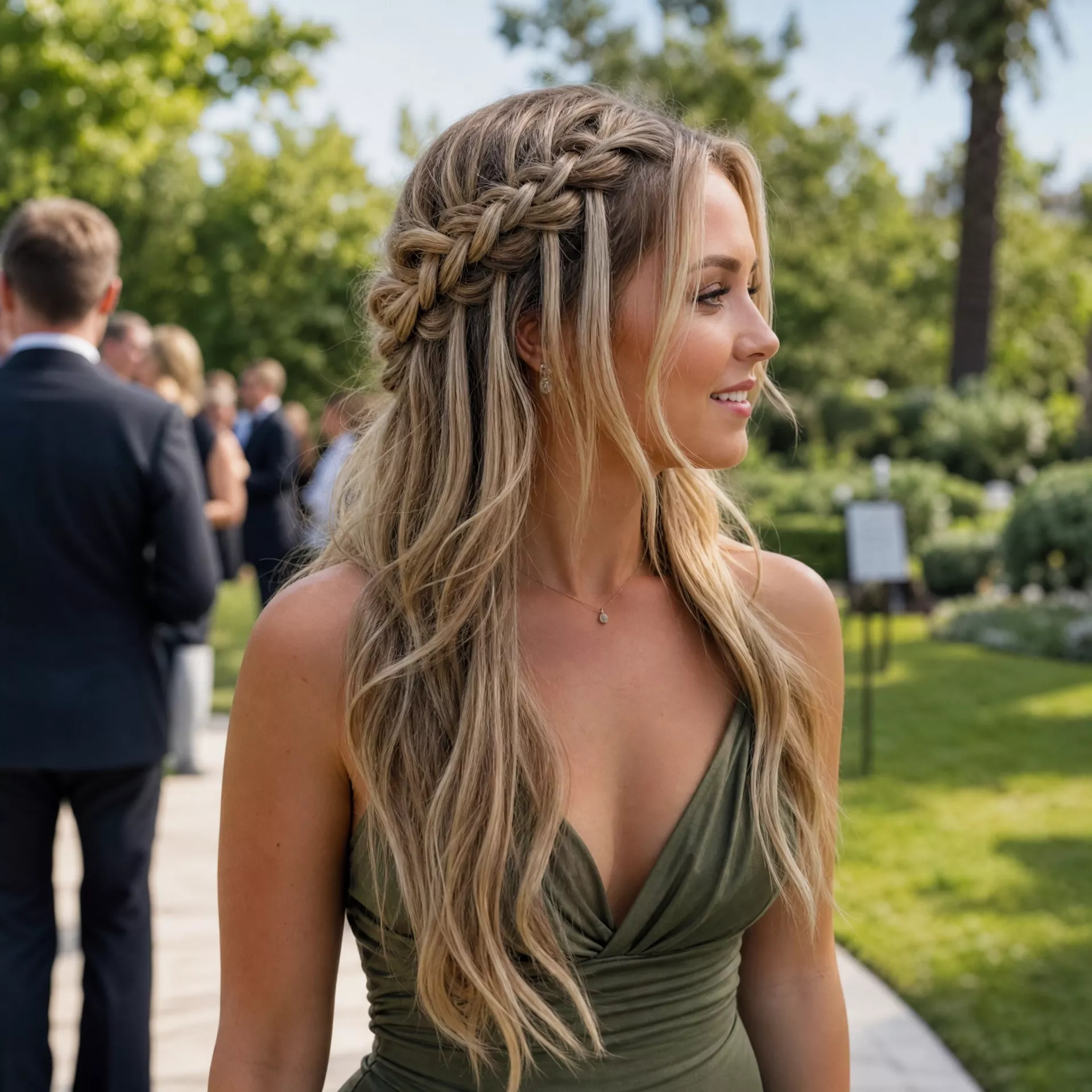
Braided Half-Up for Prom

The top section is braided, as a crown braid, two side braids meeting at the back, or a single braid, while the rest stays loose and curled or straight. Compared with the soft curls half-up, the braid adds texture and structure to the top. It suits medium and long hair. Braids help hold the top section in place, but the loose lengths below will still respond to weather and movement. Secure the braid ends with small clear elastics so they don’t unravel.
High Ponytail with Curls for Prom

The hair is gathered high on the head and secured, then the lengths are curled. It looks lifted and swings when you move. Weight matters here. Long or dense hair can drag on a high ponytail and cause discomfort over several hours, so the elastic needs to be strong. A couple of bobby pins tucked under the base help it sit up. The curls in the ponytail may loosen by the end of the night. It isn’t automatically easier or longer-lasting than an updo, so test it before committing.
Floral Accessory Updo for Prom

Flowers, fresh or artificial, are pinned into an updo, either as a few blooms or as a crown. Size, weight, and attachment all matter. Heavy flowers need anchoring with pins, and large pieces can compete with a detailed dress. Fresh flowers can wilt in heat and may not last a long evening, while silk or fabric flowers hold up better. If anyone in your group has allergies, check before choosing fresh flowers. Place them where they won’t press against your head when you sit back.
Curly Natural Hair Prom Style

Natural curls and coils can be the main feature of a prom look. Options include defined curls worn down, a curly updo, a half-up puff, or curls with a braided crown. The finished look depends on your curl pattern, density, and usual routine. Many people define their curls with a leave-in and gel on wash day, then shape them into an updo once dry. Shrinkage affects how much length you have to work with, so a style that needs length may look different on your curls. Natural texture doesn’t need straightening to look formal.
Textured Low Bun for Prom

A textured low bun sits at the nape like the sleek chignon, but with visible texture, a few loose pieces, and a softer surface. It suits semi-formal and outdoor proms. Texture spray, waves, or second-day hair help it look intentional instead of messy. It’s more forgiving than a sleek bun, because stray strands fit the look. Pin the base securely so the bun doesn’t slide down as the evening goes on.
Voluminous Blowout for Prom

A blowout uses a round brush and dryer to lift the roots, smooth the mid-lengths, and add a soft bend at the ends. It suits medium to long hair, and short hair can benefit too. How long the volume lasts depends on humidity, density, products, and technique, and fine hair may flatten sooner than thick hair. Use a heat protectant before drying. Dancing and warm rooms usually soften a blowout, so expect it to look a little different by the end of the night.
Sleek Straight and Down for Prom

Hair is straightened with a flat iron and a light smoothing product, then worn down. The minimal finish keeps attention on the dress and accessories. Naturally straight hair gets there easily, while wavy or curly hair needs more heat and may revert with humidity or sweat. Use a heat protectant and a moderate temperature. Tucking the hair behind your ears or adding a small clip can keep it off your face while you dance.
Accessories-Forward Prom Style

A simple base, such as a low bun, a half-up style, or sleek hair worn down, is built to hold statement accessories like jeweled clips, a headband, crystal pins, or a headpiece. The base matters, because heavy pieces need something secure to anchor to. Balance the accessories with your jewelry and dress. A heavily detailed dress may suit a single hair accessory instead of several. Check comfort before the night, since some headbands start pressing after a few hours.
Waterfall Braid for Prom

A waterfall braid runs horizontally across the head, dropping sections out of the braid at intervals so they fall through into the loose hair below. It frames the face and sits over loose curls or straight hair. It needs medium to long hair and some braiding experience, and it’s much harder to do on yourself than on someone else. Layered hair may slip out of the braid. Curling the lengths underneath makes the dropped sections easier to see.
Space Buns for Themed Prom

Two buns placed high on either side of the head create a playful look that suits a Y2K, retro, or other themed prom. Whether it fits depends on the event’s theme and dress code, and at a traditional formal prom it may feel out of place unless it’s your personal style. The buns can be sleek or textured, and jeweled pins or ribbons can tie them to the theme. Medium to long hair works best, though smaller buns are possible on shorter hair.
Chic Bob Style for Prom

A bob can look finished for prom without an updo. Options include a smooth blowout with a bend at the ends, soft waves, a deep side part, or one side tucked behind the ear with a jeweled clip. On a longer bob, a small half-up section with a decorative clip may work. The best finish depends on the cut. A blunt bob suits a sleek finish, while a layered bob takes waves well. A bob also leaves earrings and necklines on full display.
Fishtail Braid Updo for Prom

A fishtail braid is made by crossing small pieces between two sections, which creates a fine, woven pattern. In an updo, one or more fishtails are wrapped and pinned into a bun or shape at the back. It needs medium to long hair and patience, since fishtail braiding takes longer than a standard three-strand braid. Gently loosening the braid widens it and makes the pattern easier to see. Pin each section securely, especially on slippery hair.
Slicked-Back Wet-Look Style for Prom

A wet-look style uses gel, pomade, or a strong-hold cream to comb the hair straight back from the face into a glossy, deliberately damp-looking finish. It works on very short hair, such as a pixie, and on longer hair combed back and left down behind the ears or gathered at the nape. The result is sharp and minimal, and it shows off earrings and makeup. The trade-offs are that it relies heavily on product, can feel stiff, and may take more than one wash to remove. Test your product beforehand, since some formulas flake as they dry.
How to Match Your Prom Hairstyle to Your Dress Neckline
The neckline and back of a dress can guide your choice, but they don’t dictate it. Personal preference, hair length, and comfort matter just as much.
- Strapless and sweetheart: an updo shows the shoulders and collarbones, while hair down or half-up adds some coverage. Both can work well.
- One-shoulder and asymmetric: a side-swept style toward the bare shoulder balances the line, or an updo keeps the asymmetry clear.
- High neck: an updo keeps hair off the collar, while long hair worn down may hide neckline details.
- Halter: updos and high ponytails keep the straps visible.
- Open back: updos and side-swept styles show the back, and long hair worn down will cover it.
- Detailed shoulders, sleeves, or embellishments: simpler hair keeps attention on the dress, and an updo prevents hair from catching on beading.
Which Prom Hairstyles Work for Short, Medium, and Long Hair?
Short and bob-length hair: the chic bob styles, the slicked-back wet look, sleek straight hair, a blowout, and accessories-forward looks work well. Small half-up sections and decorative clips add detail.
Medium hair: most half-up styles, low buns, twisted updos, the side sweep, and loose curls are realistic. Some updos may need extra pins or a small bun form.
Long hair: nearly every style on the list is possible. Heavy hair may need more support in updos and can make high ponytails uncomfortable.
Clip-in extensions can add length or volume for a specific style, but they’re entirely optional.
How to Choose a Prom Hairstyle for Your Hair Texture
Texture and density are different things. Texture describes whether hair is straight, wavy, curly, or coily, and density describes how many strands there are.
- Fine or low-density hair: texture spray helps pins grip, and a bun form can add fullness to updos. Teasing is one option, not a requirement.
- Thick or high-density hair: updos may need more pins and more time, and heavy ponytails can strain the scalp. Dividing hair into smaller sections makes styling easier.
- Straight hair: holds sleek styles easily but may drop curls, so setting curls as they cool helps.
- Wavy hair: takes to waves, textured buns, and messy updos with little help.
- Curly and coily hair: can be worn naturally in defined curls, curly updos, puffs, or braided styles. Shrinkage changes how much length is available, and natural texture doesn’t need to be changed to look formal.
How to Coordinate Your Hairstyle With Prom Accessories
Hair placement changes what people see. Updos and side sweeps show off earrings, while hair down partly covers them. A statement necklace may call for hair pulled back or swept to one side. If your dress is detailed, one hair accessory is usually enough.
For hair clips, jeweled pins, headbands, headpieces, and ribbons, consider weight and attachment. Heavy pieces need an anchor of crossed bobby pins underneath. Check that nothing snags on your hair or dress, and wear the accessories for a little while beforehand to make sure they stay comfortable.
How to Make Your Prom Hairstyle Last Through Dancing
- Practice unfamiliar styles beforehand so you know how they hold.
- Prepare your hair for the technique. Some updos grip better on second-day hair, while sleek styles often look best freshly washed.
- Use hold products in moderation, since too much makes hair stiff or sticky.
- Choose pins and elastics suited to your hair’s thickness, and cross pins for a firmer grip.
- Consider humidity, wind, and how warm the venue will be.
- Carry a small touch-up kit with spare pins, a mini comb, an elastic, and blotting paper.
- Avoid touching or adjusting the style repeatedly, which loosens it.
Different styles behave differently over a long night. Sculpted waves soften, natural curls may expand, sleek hair can frizz, and pinned updos may loosen around the edges.
Should You Do Your Prom Hair Yourself or Visit a Salon?
Many styles are manageable at home with practice, including the high bun, low buns, half-up styles, loose curls, a blowout, sleek straight hair, and bob styling. Others, such as Old Hollywood waves, waterfall braids, princess updos, and complex braided updos, take more experience. Consider your skill, how complex the style is, your hair’s length and texture, the time you have, and your budget. A good way to decide is to practice the style once and see how it holds and feels. If it’s hard to reproduce, professional help may be worth it.
When to Book Your Prom Hairstylist and How to Prepare
Prom dates can be busy for local salons, so it’s sensible to contact a stylist early, especially if you have someone specific in mind. When you book:
- Confirm the date, time, price, and services included.
- Share a reference photo of the style you want.
- Show a photo of your dress, including the neckline and back.
- Mention your hair length, texture, and any styling preferences.
- Ask how to wash and prepare your hair beforehand.
- Check how long the appointment will take, so you can plan the rest of your day.
A Practical Prom-Day Hair Timeline
- Weeks before: choose a style, look at your dress with it in mind, and book a stylist if you’re using one.
- Days before: do a trial run if the style is new, and gather accessories, pins, and products.
- The evening before: prepare your hair as your stylist suggested or as your chosen style requires.
- On the day: allow more time than you think you’ll need, including time to get dressed without disturbing your hair.
- Before leaving: check the back with a hand mirror, secure any loose pins, and pack your touch-up kit.
Common Prom Hairstyle Mistakes to Avoid
- Choosing a complicated style without testing it first.
- Picking a style that clashes with the dress or feels uncomfortable.
- Using so much product that hair turns stiff or sticky.
- Wearing heavy or poorly secured accessories.
- Ignoring the weather and the venue.
- Using high heat without a heat protectant.
- Choosing a style that keeps falling into your eyes.
- Leaving no time for touch-ups.
- Copying a reference photo without considering differences in length, density, or texture.
How to Choose Between Similar Prom Hairstyles
High bun or princess updo: a high bun is a single wrapped shape at the crown. A princess updo is fuller, uses teasing or padding, and often includes curls or a headpiece, so it takes more time and skill.
Sleek low chignon or textured low bun: both sit at the nape. The chignon is smooth and formal, while the textured bun is softer and more forgiving of flyaways.
Loose romantic curls or Old Hollywood waves: loose curls are open and soft. Old Hollywood waves are brushed into defined, uniform ridges, which takes more precision.
Soft curls half-up or braided half-up: both keep the top section secure. The braid adds texture and structure on top, while the curls version keeps it simple.
High ponytail with curls or a fully down style: the ponytail keeps hair off your neck and shoulders, which helps on warm nights. Hair worn down frames the face but may need more touch-ups.
Waterfall braid or Dutch braid crown: the waterfall drops sections into loose hair, keeping most of it down. The Dutch crown wraps around the head and keeps hair off the face and neck.
Accessories-forward style or floral accessory updo: the accessories-forward style uses a simple base for jeweled or metallic pieces, while the floral updo centers on flowers, which bring their own concerns about wilting and weight.
Frequently Asked Questions About Prom Hairstyles
Which prom hairstyles work well with a strapless dress?
Updos show the shoulders and collarbones, while loose curls or a half-up style add some coverage. Both can work, depending on your preference.
What are some prom hairstyles for short hair?
Styled bobs, sleek straight hair, a blowout, a slicked-back wet look, and accessories such as jeweled clips all suit short hair.
Should I wear my hair up or down for prom?
Consider your dress neckline, the weather, and your comfort. Up keeps hair off your neck and shows off the dress, while down frames the face.
How can I make my prom hairstyle last longer?
Practice it, prepare your hair for the technique, use pins and products in moderation, and carry a touch-up kit. Some change over the evening is normal.
Should I wash my hair on prom day?
It depends on the style and your hair. Some updos hold better on second-day hair, while sleek styles often need clean hair. If you’re seeing a stylist, follow their advice.
Can I wear my natural curls to prom?
Yes. Defined curls, curly updos, puffs, and braided styles can all be formal without straightening.
Is it worth booking a professional hairstylist?
It can be for complex styles or if you’re not comfortable styling. Simpler looks are often manageable at home with practice.
When should I book my prom hairstyle appointment?
Contact your salon early, since prom dates can fill up. Availability varies, so ask the salon directly.
What should I bring to a prom hair appointment?
Bring reference photos, a photo of your dress, and any accessories you plan to wear in your hair.
How can I choose a hairstyle that feels comfortable while dancing?
Avoid very tight or heavy styles, test the style for a few hours beforehand, and choose one that keeps hair out of your face.
Final Thoughts
Start with your dress and your hair length, then narrow the list to two or three styles that suit your texture and comfort. Try your favorite at home if it’s new to you, decide whether you need a stylist, and plan a little extra time on the day. The best prom hairstyle is the one that holds up, feels comfortable, and still looks like you when the night is over.