26 Half-Up Hairstyles for Straight Hair and How to Choose the Right One
Straight hair shows exactly where it has been divided, lifted, twisted, or clipped. Every parting line, pin, and elastic is visible, which can be an advantage: a half-up style creates a clear shape without curling or restyling the whole length.
The same half-up can look quite different from one head to the next. Density decides how much hair there is to gather, and strand thickness affects how well pins and clips grip. Length limits what’s possible, and your natural part and any layers change what stays in place and what escapes. How much hair you gather matters as much as the style itself.
The 26 styles below look at what each half-up structure does to straight hair, whether it’s a twist, clip, braid, bow, knot, or bun. The aim is to help you choose the structure that suits your hair, not simply copy a photo.
Classic Half-Up Twist

The basic structure is a top section gathered, twisted back, and pinned or secured at the crown. How much hair you take changes the result. A small section keeps most of the length loose and barely alters the silhouette, while a larger one lifts the shape and leaves less hair down. On straight hair, the twist looks clean and defined, but very smooth strands can slide out of their pins. Crossing two pins in an X, or adding a light texturizing product, usually holds better than pulling the twist tighter.
Half-Up Claw Clip Style

Clip size has to match the hair. A small clip may not hold enough hair, and a very large one can swallow fine or low-density hair and look oversized. Placement shifts the shape: higher on the crown gives lift, while lower sits closer to the head. Dense hair needs a sturdy clip with strong teeth, and slippery straight hair may hold better if the section is twisted before clipping. The clip doubles as the accessory, so check whether it’s decorative or doing the holding.
Half-Up with Small Front Braids

Straight hair has little surface texture of its own, so a thin braid at each temple adds some without changing the rest of the style. The braids work best as accents, kept slim and pinned or tied at the back with the rest of the hair loose. Shorter layers and fine hairs near the hairline tend to escape a braid, which can look soft or untidy depending on your preference. On fine hair, loosening the edges slightly makes the braids look wider, though it doesn’t add any hair.
Sleek Half-Up Ponytail

The contrast is between a controlled upper section and loose, straight lengths. Ponytail height shifts the effect: a high one lifts the crown, while a lower one sits closer to the head. Sleekness is a finish, not a given. Naturally straight hair may need only brushing and a little smoothing product, while heat-straightened hair has to be redone after each wash. Flyaways at the hairline are the usual giveaway, and a very tight pull can strain the scalp, especially if you wear it often.
Half-Up Bow Style

The bow is made from your own hair, usually by dividing the top section into two loops and wrapping the tail across the middle. That means length and density decide whether it looks like a bow at all. Medium and long hair give enough loop length. Fine or low-density hair tends to make a smaller bow, and shorter hair may not have enough to form two loops. Straight hair keeps the shape clear, but it can slip, so the center usually needs a firm elastic and a pin.
Twisted Crown Half-Up

Here, twists run along each side of the head and meet at the back, so the question is where they’re anchored. Twisting too much hair makes the crown look heavy and can pull at the temples, so smaller sections tend to sit better. Symmetry depends on your natural part: if it leans to one side, the twists may start at different angles and look uneven. Pins placed at the join hold the structure, and straight hair with some grip keeps the twists from loosening.
Half-Up Bun

A small knot and a substantial bun are different styles. Dense, long hair makes a full bun that sits high and may need extra pins, while finer or shorter hair makes a smaller one. Placement changes the profile, since a bun at the crown adds vertical height. The remaining loose hair hangs straight, which can look neat or flat depending on its length. Straight hair shows the bun’s shape clearly, so uneven wrapping is visible, and a softer wrap hides small imperfections.
Low Half-Up Tie-Back

Gathering at a lower point changes the silhouette. Instead of lifting the crown, the tie-back keeps the shape close to the head, which suits anyone who wants structure without obvious height. It simply controls the front and sides, and the loose lengths fall as they normally would. It doesn’t depend on volume or elaborate pinning, so it can feel more restrained than a crown-level half-up. A small elastic or clip is usually enough, though very smooth hair may need a firmer one.
Half-Up with Barrette

The barrette is the anchor. Its size and strength decide how much hair it can hold, so a small barrette suits a thin section, while a thick or dense section may slide out of it. Straight hair shows the accessory clearly, which makes placement important: closer to the crown holds a lifted section, closer to the back sits flatter. It’s worth checking whether the barrette is holding the hair or merely decorating a section already secured with an elastic, because that determines how much it can carry.
Bubble Half-Up Hairstyle

Bubbles come from elastics spaced down the tail, with each section gently pulled outward. Straight hair makes the geometry very clear, since the rounded shapes stand out against smooth lengths. Spacing and tension decide the look: even gaps give regular bubbles, while uneven ones look accidental. Too many bubbles can crowd the top and make the style look busy, so fewer, larger sections often read more cleanly. Dense hair gives fuller bubbles, and finer hair makes smaller ones that need more careful pulling.
Half-Up with Ribbon

Ribbon adds visual weight as well as color. A thin one reads as a detail, while a wide one becomes the focus. How it holds depends on the material: slippery satin can slide off smooth hair, while grosgrain or textured ribbon grips better. A bow tied over a gathered section may look decorative, but a ribbon wrapped around the elastic can also hide it. On fine or low-density hair, a heavy ribbon may pull the section down, and dense hair may need the ribbon tied around something firm.
Half-Up Top Knot

The knot sits at the crown, so it changes the profile more than a lower half-up. Its size depends on how much hair goes into it, and it needs enough length to wrap and secure. Fine or low-density hair may make a smaller, tighter knot. Dense hair makes a larger one that needs more pins. Slightly textured or second-day hair can grip better than freshly washed, very smooth hair, though that varies by person. Keeping the tension moderate avoids pulling at the hairline.
Twisted Half-Up on Shoulder-Length Hair

Shoulder length leaves less hair to work with, which shapes every decision here. The twist is shorter and may need to be gathered closer to the crown. Layers can escape, so shorter pieces near the nape or sides may fall out of the twist, and the tie-back should sit where there’s enough length to anchor it. The remaining ends behave differently as well, since they may flip outward where they meet the shoulders. A smaller section tends to hold better than a large one.
Half-Up with Curtain Bangs

Curtain bangs and a half-up share the front of the head, so what matters is what stays loose. The bangs usually remain free and part at the center, and the half-up section starts behind them. Leaving a few side pieces out keeps some framing around the face, while pulling them in creates a cleaner look. Your natural part decides how the bangs sit, and a quick blow-dry often helps them open. A half-up can also keep the bangs from falling into the eyes by controlling the hair behind them.
Polished Half-Up for Work

“Polished” here describes how controlled the hair looks, not who should wear it. Secure placement and clean sectioning matter most, so the style holds through a day of movement. A restrained accessory, or none at all, keeps it simple. How many loose strands you leave out is a matter of taste, since some people prefer a neat finish and others a softer one. Straight hair shows the parting line clearly, so combing it cleanly before gathering helps, and the elastic should be comfortable over several hours.
Braided Half-Up Straight Hair

One braid is enough to turn a half-up into something textured, and it can be the main structural feature. Straight hair makes the braid pattern very visible against smooth lengths. Placement matters: a braid running along one side shifts the style asymmetrically, while one across the crown acts like a headband. Section size changes the weight. A thin braid reads as a detail and a thick one as a feature. Slippery hair may need a little product for grip so the braid doesn’t loosen.
Half-Up Pony with Wrapped Base

Wrapping a small section of hair around the elastic hides it and leaves the ponytail looking cleaner. It takes a thin strand from the ponytail itself, so fine or low-density hair has less to spare. The wrap is anchored with a pin pushed through it into the base. Very silky hair can release the wrap as it moves, so a firm pin or a small elastic underneath helps. Wrapping works best when the tail has enough length to cover the elastic fully.
Romantic Half-Up with Soft Ends

Straight hair doesn’t have soft ends on its own. The softness comes from styling: a slight bend with a round brush while blow-drying, a flat iron turned inward, or a loose curl at the tips. The haircut matters too, since hair cut with a soft, slightly tapered edge turns under more easily than a blunt one. Without styling, the ends may simply hang straight. The half-up section stays the same, so the finish is a separate decision and can be adjusted independently of the structure.
Minimalist Half-Up Pin Back

One or two pins gather a small section at the side or back, changing the silhouette without taking much hair. It needs very little length, which makes it workable on shorter straight hair. The weakness is grip. A pin slid into smooth strands can slip out, so placing it into a lightly twisted section or crossing two pins holds better. It doesn’t lift the crown or add volume, so the result is subtle: the hair stays down, but one side is kept clear of the face.
Half-Up with Center Part

A center part creates symmetry and shows where the hair is divided, which suits straight hair because the line stays visible. It works most easily when your hair naturally parts near the middle. If your natural part sits to one side, it may resist a perfectly centered division and drift back through the day. On lower-density hair, a center part can show more scalp along the line. The gathered section then sits behind it, so the balance of the whole style depends on how evenly it’s divided.
Half-Up with Volume at Crown

Crown volume depends on your density, strand thickness, growth pattern, haircut, and styling, so straight hair doesn’t automatically lack it. Some hair sits flat and some doesn’t. If you want lift, root-lifting product or a quick blow-dry at the crown can raise the top. Gently backcombing the section before gathering also adds height, but it should be done sparingly, since repeated teasing can cause tangling and strain. Lift often relaxes over the day, so a moderate amount tends to look more consistent than a strong one.
Half-Up Space Buns

Two small buns sit on either side of the top section, and symmetry is the main thing to get right. Section size and bun size are linked: very small buns suit medium-length hair, while larger ones need more length and density. On fine or low-density hair, each bun may look small, which can read as neat or sparse depending on your preference. Straight hair makes any unevenness visible, so the parting and elastic placement matter. The loose lengths underneath hang straight, which keeps the overall look balanced.
Knotted Half-Up Hairstyle

The knot is made by tying the gathered section on itself, usually with the ends tucked or pinned. How much hair you gather decides how large it looks. Straight hair shows the knot’s structure clearly, but it also slips, so pins are often needed at the point where the ends tuck under. Longer hair makes a more substantial knot, and shorter hair may not have enough length to tie. It needs some practice to get the tension right, and a loose knot holds less securely than a tight one.
Half-Up with Pearl Clips

Pearl clips can be structural, holding a section in place, or decorative, sitting on top of one that’s already secured. Size and number change the look: a few small clips along a side read as a detail, while one large clip becomes the focus. Straight hair shows the clips clearly, but smooth strands can let them slide, so they hold better in a twisted or lightly textured section. Dense hair may overpower small clips, and heavier ones can pull fine hair downward over time.
Easy Half-Up for Long Straight Hair

Very long straight hair worn fully loose can hang as one long, heavy panel, and a half-up changes how that length is distributed. Gathering the top section breaks up the line and shifts some weight to the crown. It doesn’t automatically make long hair more flattering, but it can change the proportions. Weight is a practical issue: a heavy section clipped at the crown pulls on the hold, so a sturdy clip or firm elastic helps. A looser gather is gentler on the scalp.
Half-Up with Tiny Twists

Small twists near the face add detail without changing the clean finish of the rest of the hair. They can be as few as one on each side or several in a row, and each one takes only a little hair. That size is useful, since small sections are often easier to secure than large ones and can be pinned or gathered at the back. Where they begin matters: near the hairline they frame the face, further back they sit more discreetly. On straight hair, shorter pieces may slip out, so a pin at the end helps.
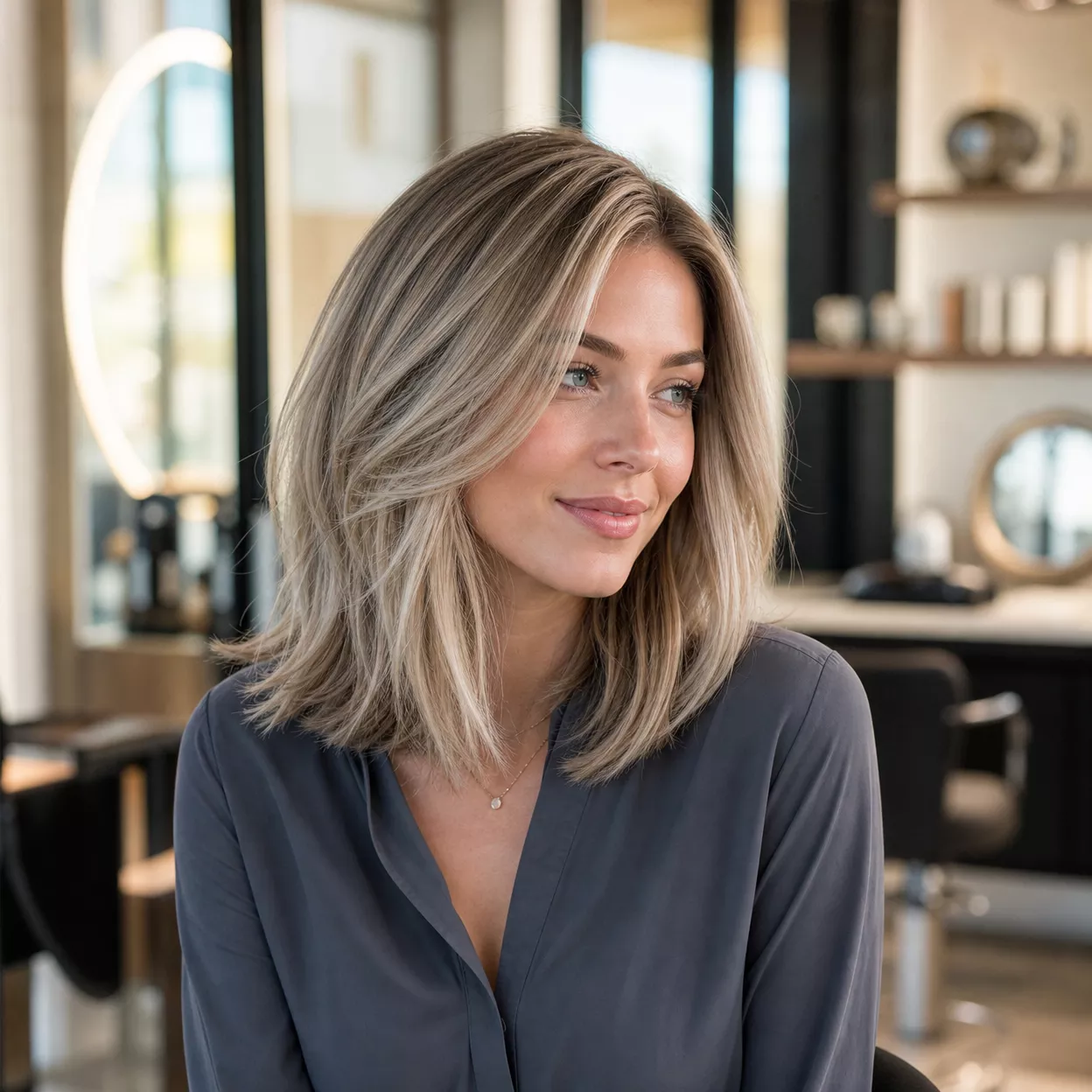
The Half-Up Photo Doesn’t Tell You Everything
A hairstyle photo shows the finished shape but hides most of what produced it. You can’t see the model’s density or strand thickness, or how long her hair is. Hidden pins and extra elastics may be doing more work than the visible clip. Heat styling, product, and extensions can all change how smooth or full the hair looks, and lighting can hide flyaways or make the surface shine.
Look for how the section is held, where the parting falls, and what the loose lengths do. Treat the photo as a guide to structure, because your own hair will behave a little differently.
How Much Hair Should You Actually Put Into a Half-Up Style?
Section size changes the result more than most people expect. A small section leaves more hair loose, gives subtler structure, and adds less weight. A large section creates a stronger visual change and more control, but leaves less hair down and can put more tension on the scalp.
The right amount depends on your density and the shape you want. Dense hair can make a large section look heavy, so a smaller one may sit better. Fine or low-density hair can look sparse if too much is gathered, so a moderate section often keeps the loose lengths looking fuller.
Fine, Dense, Thick, or Silky: Straight Hair Behaves Differently
Straight hair isn’t one type. Fine hair has narrow strands, and low density means fewer strands. Fine but dense hair can handle a substantial gathered section, while fine, low-density hair usually does better with a smaller one and a lighter accessory.
Thick can mean dense, coarse, or both. Dense hair makes full buns and needs stronger pins and clips. Coarse strands hold shape but can feel stiff. Silky or slippery hair, whatever its thickness, tends to let pins, clips, and ribbons slide, so a little grip from a twist or product helps. Volume, hold, and section size all vary accordingly.
What Changes When Your Hair Is Shoulder Length Instead of Long?
Length decides how much hair is available to gather. Shoulder-length hair can be pulled into a twist, small bun, or tie-back, though each one will be smaller than in a long-hair photo. Twists are shorter, buns tighter, and layers near the nape may escape.
Placement shifts too. A tie-back may sit higher to have enough length to hold, and loose ends may flip outward where they meet the shoulders. Neither length is better. Long hair gives more room for knots, bows, and large buns, while shoulder length suits simpler, smaller structures like pin-backs and tiny twists.
When a Half-Up Style May Not Behave the Way You Expect
Silky hair can slip out of pins and elastics, and clips may open if they hold too much. Fine hair can look sparse when too large a section is gathered, while dense hair can overwhelm small clips. Layers often escape, leaving loose pieces around the nape or temples. Crown volume may collapse over the day, and heavy accessories can pull sections down. A tight tie can become uncomfortable.
Most of these are fixed by adjusting the section size, adding grip with a twist or light product, or using a stronger clip. A looser, smaller gather is often the more reliable option.
How to Choose One of These 26 Styles
Start with length, since it decides which structures are possible: pin-backs and tiny twists need little, while buns, knots, and bows need more. Then consider density and strand thickness, which affect how much hair you can gather and how well things hold.
Think about your natural part, because center-part and curtain-bang styles work best when they follow it. Decide how much volume you want and how much hair you’d like loose. Then consider the occasion, any accessory you want to use, how much time you have, and how secure the style needs to be. A day of movement asks more of a hairstyle than an hour at dinner.
What to Tell Your Stylist or What to Look For When Copying a Photo
These are styling ideas more than haircuts, but you can still describe what you want, whether to a stylist or in the mirror:
“I want the top section to be small and leave most of the length loose.”
“I want the crown smooth rather than lifted.”
“I want the front pieces left outside the half-up section.”
“I want the accessory to hold the section rather than simply decorate it.”
“I don’t want the style to depend on daily heat.”
Look for how the section is held, how much hair is gathered, and what the loose lengths are doing.
Final Thoughts
Straight hair doesn’t need a complicated routine. A half-up style works by changing one controlled section while the natural straight length stays visible. The result depends on how much hair you gather, where it’s anchored, and how well your hair holds. Use the 26 styles above to find the structure that suits your length and density, then adjust the section size and hold to your own hair.