26 Bridal Hairstyles for Medium Length Hair and How to Choose the Right One
Medium length hair gives a bride a lot of options, but the style in a reference photo may not behave the same way on your head. How it turns out depends on your density, texture, and length, and on how much hair there is to pin once it’s curled, twisted, or braided. Humidity, a veil, and a long day of hugging and dancing all test the style further.
So the goal isn’t to find the most appealing photo. It’s to find a style that works with your actual hair, stays comfortable for hours, and suits the setting. It also needs to work with whatever you’re wearing in it, and it should still feel like you.
The 26 styles below run in one continuous sequence. Each points to the practical detail that matters most, whether that’s veil placement, the length a shape needs, hold, or what the back looks like.
Low Romantic Chignon

A chignon at the nape is a shape medium hair can often manage, since it needs less length than a high or very large updo. The detail to look at is how much hair is gathered. A fuller, looser knot needs more length and density, while a smaller one sits neatly on most medium cuts. Loose pieces at the temples soften the front, but they’re also the first thing to drop, so ask how they’ll be secured. If you’re wearing a veil, the chignon gives it a base, so your stylist should know where it will attach before the shape is built.
Half-Up Twisted Crown

The top section is twisted back and pinned at the crown, while the rest stays down. Its security depends on grip. Hair with some texture holds twists readily, while very fine or smooth hair may slip and need extra pins or a light texture product. Because the lengths stay loose, they’ll move and may need minor adjustments across the day. This style leaves the back of the head relatively open, which makes it easy to pair with a comb or clip, as long as the twist is anchored firmly enough to carry it.
Loose Wavy Half Updo

Two things are happening here: a gathered top section and waves below. The waves are the part to think about. Hair that already bends may hold them with little help, while straight hair usually needs curling and setting, and humidity can relax the waves over the course of a day. Curling also shortens medium-length hair, so the loose section will sit higher than its straight length suggests. A trial shows you how your hair holds waves and how short they sit once set.
Bridal Low Bun with Pearls or Pins

The bun is the structure, and the pearl or crystal pins are the accessory. Pins add a little weight and need something to anchor into, so the bun has to be secure on its own. Dense hair holds decorative pins readily. Finer or lower-density hair may need the pins placed through a firmer section or backed by hidden pins. Keep in mind how the pins sit alongside a veil, since both want space at the back of the head and can crowd each other.
Soft Updo with Braided Detail

A small braid through the crown adds texture at the back of the head, which matters because that’s the view guests see during a ceremony. On medium hair, the braid is usually short, so it works as a detail rather than a main feature. The rest of the updo is loosely pinned, which tends to look softer but depends on good pinning to last. Floral accessories or a veil can sit near the braid, so tell your stylist what’s going in before the shape is finalized.
Loose French Twist with Face-Framing Curls

A French twist rolls the hair vertically and pins it along the back of the head, and it needs enough length to wrap and secure. On medium hair, that’s often possible at the longer end of the range and tighter at the shorter end. A loose version is more forgiving than a sleek one. The curls at the front are a separate piece of styling and need to hold their shape, so ask how they’ll be set. How well the twist lasts depends on texture, preparation, and technique, not on the style name.
Bohemian Braided Half-Up

Small braids from the temples gather at the back, leaving the rest loose. The style suits outdoor settings, but wind will move the loose lengths, so it’s worth planning for that. Braids hold more securely on hair with a little texture, and fresh, very smooth hair can slip. Flowers or small accessories woven through the braids add weight and need pinning. Natural wave or curl in the lower section can look relaxed with little styling, while straight hair may need added texture to match the reference.
Sleek Blowout with Side Part

No pins, no braids, nothing to anchor except the part. That simplicity is the appeal, and it also means the style depends entirely on how your hair holds smoothness, which humidity can change quickly. A side part shifts hair across the forehead and should follow your natural part. It also leaves one ear and more of the neckline visible, so it’s worth checking how earrings and the neckline look with it. If you’re wearing a veil, ask where it will sit with hair worn down.
Romantic Curls with Soft Updo

Here, curls are pinned into a loose updo, so the shape comes from the curls rather than from smoothing. How that looks depends on your pattern. Straight hair needs curling and setting, and curls can relax over the day. Naturally curly hair can be gathered with its pattern intact, though shrinkage means it will sit shorter and fuller than it looks wet. If the reference photo shows a different curl pattern from yours, ask your stylist to adjust the shape to what your hair actually does.
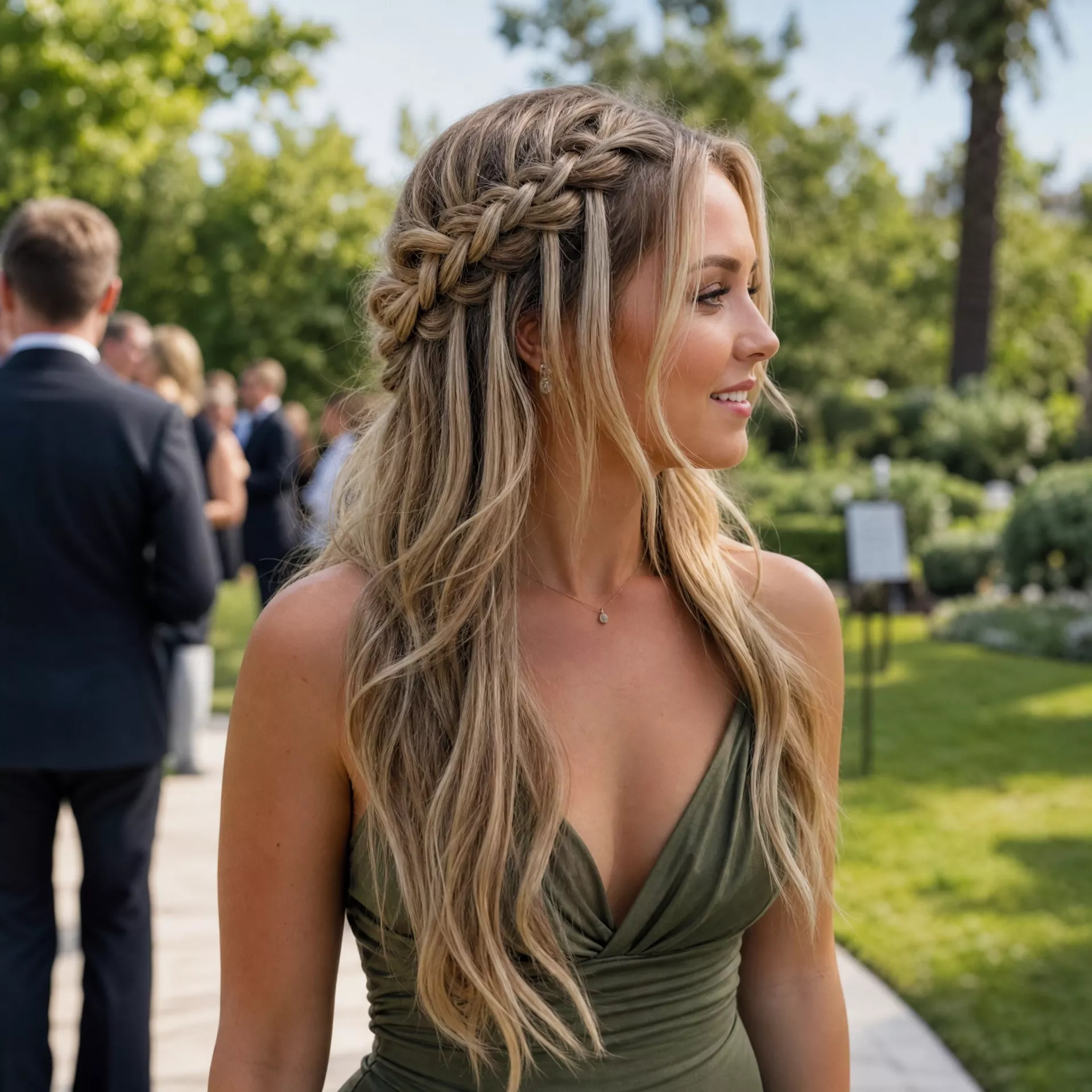
Half-Up with Braided Crown and Loose Waves

This style combines three pieces: a braid, a half-up gathering, and loose waves. Each adds a step, so it usually takes more preparation than a simpler half-up. On medium hair, the braid across the crown may be short, and curling the lower section shortens the lengths further. That’s worth knowing before you fall in love with a reference photo whose model has longer hair. A trial lets you see whether the proportions work at your length.
Sleek Low Ponytail with Wrap Detail

A low ponytail is among the least complicated styles on this list, and the wrapped section hides the elastic. That piece uses hair from the ponytail itself, so on fine or low-density hair, the tail may look slimmer once a section is taken. A smaller wrap, or a small hidden elastic with an accessory, can solve that. A veil can sit above the ponytail, but the placement needs planning, since the veil and the elastic occupy the same area. Keeping it smooth depends on your texture and the weather.
Textured Updo with Loose Pieces

Texture makes an updo more forgiving, since slight movement looks intended rather than undone. Hair with some grip or second-day texture pins more securely than freshly smooth hair, which is partly why stylists often prep hair before pinning. The loose pieces at the front need a plan, because they’re the first thing to change as the day goes on. Ask whether they’re curled and set, and whether a quick touch-up is realistic. It tends to suit someone who prefers a relaxed finish over a precise one.
Side Swept Wave Style

Hair is waved and swept to one side, so the style is asymmetrical by design. That makes the side matter. The exposed side shows the ear, neck, and any earring, while the swept side carries most of the volume. If your dress has a detailed neckline or back, think about how the two relate in photos. Heavy waves worn to one side can slide, so ask how they’ll be pinned. Wind can also shift the sweep outdoors.
Braided Low Bun

The braid is coiled into a low bun, which tends to be secure because a braid is easier to pin than loose hair. The back view is the point: the braid shows its pattern and the bun sits at the nape, a view guests see during a ceremony. Medium length is enough for a shorter braid and a modest bun. Dense hair can make a thick, substantial bun; finer hair may make a smaller one, and the braid can be loosened slightly for width. Check how it looks against the back of your dress.
Soft Voluminous Half-Up

Fine hair and low-density hair are different. Fine hair has narrow strands, while low-density hair has fewer of them. Volume at the crown, created by lifting the roots or gently teasing the section before it’s gathered, can create the appearance of fullness in either, but it doesn’t change density. Fine hair with good density may hold volume well. Low-density hair may need a smaller gathered section or added hair to keep the crown from looking sparse. Ask how the volume is secured and how long it tends to last.
Boho Fishtail Braid Updo

A fishtail uses many narrow sections, so it needs more length than it appears to, and medium hair may produce a shorter, narrower braid than the reference. It’s worth asking whether your length supports it or whether added hair would help. The braid takes skill and time, which affects the schedule on the wedding morning. Small flowers or crystals can be woven in, though they add weight and need securing. Fishtails often look better on hair with some texture to hold the pattern.
French Braid Half-Up

A French braid gathers hair as it travels along the head, which gives it a firm anchor to the scalp. That can make it a practical option for a long day, though how well it holds depends on texture, preparation, and technique. Tension is the thing to check at a trial: a braid pulled very tight may become uncomfortable after hours. If you’re wearing a veil or comb, ask whether it will attach over or beside the braid, since the braid affects where a comb can sit.
Pinned Back Natural Waves

Pinning back one or both sides keeps natural waves worn down, which can suit someone who wants to keep their own texture. The weak point is the pin. If it slips, the style loosens, so ask how it’s secured and whether a comb or clip will hold better than a single pin. Waves that aren’t consistent may need some shaping to match the reference. Humidity can change natural waves, making them fuller or frizzier, so a trial in similar conditions gives a more honest preview.
Elegant Chignon with Veil

Here, the question is the veil. A chignon gives it a firm shape to attach to, and the attachment point changes the look: a veil placed above the chignon sits differently from one tucked beneath it, and the chignon needs to be secure enough to carry it. Bring the veil to the trial, since its weight and length affect where it can sit. Medium hair is enough for a compact chignon, though a very large one may need more length or added hair.
Loose Romantic Bun with Tendrils

A looser bun is less secure by design, since softness means fewer tight pins. That makes it worth asking how it will hold through a ceremony and reception, and whether a touch-up is possible. The tendrils at the temples are usually curled and may drop over time. Texture helps with grip: slightly textured hair holds a loose bun more readily than freshly smoothed hair. The placement, low at the nape or higher on the head, changes how it relates to a veil and the neckline.
Twisted Half Updo with Volume

Volume and a twist share the crown, so the style is partly about shape. On dense hair, the crown can look full, and the gathered section may need strong pins. On fine hair, the volume is more fragile and may need support. Neither thick nor fine hair is a problem for this style, but each needs a different approach. Ask how the volume is built and how it holds when you sit, hug, and turn your head.
Sleek Middle Part with Long Waves

The word “long” matters here, because setting waves into medium hair shortens it, sometimes noticeably, so the finished length may land higher than expected. Whether that suits you is a matter of preference, but it’s worth knowing. With hair left down, the veil needs a different anchor, often a comb placed higher or lower than with an updo. A center part works most easily when it matches your natural part, and the sleek top depends on how well your hair stays smooth.
Updo with Braided Halo

A halo braid wraps around the head, so it needs enough length to reach around. Medium hair can sometimes manage a thin halo, but a fuller one may need extensions or added hair, and it’s better to learn that at a trial than on the wedding morning. Once it’s in, the braid itself is a secure structure. Floral accents or no accessories at all can both work, but any accessories need to attach to the braid rather than loose hair.
Classic Half-Up Half-Down

A half-up gives a veil or comb a stable place to attach, because the gathered section anchors it, while the rest of the hair stays loose. That flexibility makes it a practical choice, though it doesn’t suit every gown or setting automatically. It’s also adaptable to different textures: smooth, wavy, or curled lengths all work, depending on your hair. Because the lower section is free, it will move, so ask how much touching up you should expect.
Low Side Bun with Soft Waves

A side bun changes the profile: it’s visible from the side and the back, but less from the front. The waves at the front add softness, and the bun sits low behind one ear. As with other asymmetrical styles, check how it relates to your earrings, neckline, and any back detail on the dress. A bun placed to one side can feel heavier on that side, so ask how it’s secured and whether it feels balanced. Pins or small accessories add detail but also weight.
Textured Crown Braid with Loose Ends

The braid runs across the crown and the ends stay loose, so how it looks depends on length. Medium hair may produce a shorter braid and shorter loose ends, particularly after curling. Floral and crystal details add weight and need pinning to the braid itself. The loose lengths will move in wind, so it’s worth thinking about the setting. Because it looks undone by design, it can be forgiving of small shifts, though a braid that slips from its pins is hard to repair mid-day.
The Real Question: What Does Your Hair Need From the Style?
Start with your hair rather than the photo.
Density decides how much hair you have to gather. Dense hair makes full buns and braids but needs stronger pins, while lower-density hair may need smaller shapes or added hair. Strand thickness is separate: fine strands may slip and need more grip, and coarse strands hold shape but can feel bulky. Texture matters too. Straight hair holds curls and waves differently from naturally wavy hair, and curly and coily hair can be styled with its pattern intact.
Length sets the limits. Natural movement affects how a style settles. And the hold you need depends on the day. A long wedding with dancing asks more of a style than a short ceremony.
Comfort is part of the decision. A style you’re aware of for hours isn’t doing its job.
Medium Length Hair Has Limits, and That’s Okay
Some reference photos depend on more hair than medium length provides. A full halo braid, a large fishtail, or a heavy chignon may need extensions or added hair to match. That isn’t a failure. Added hair is a common tool, and a stylist can tell you early whether it would help.
Other times, the answer is a modified shape: a smaller bun, a shorter braid, a different pinning pattern, or a slightly different volume. Asking “Will my current length support this?” at the trial tells you whether to adjust the style or adjust the hair.
Look at the Back of the Hairstyle Before You Save the Photo
Most reference photos show the front, but much of a ceremony is seen from behind.
Check the back view: where the bun sits, how the braid runs, and where the pins and accessories are placed. Consider how the veil will attach and where it will fall. Think about your neckline and the back of the dress, since the hairstyle and the dress both occupy the same view. If you’ll be photographed from behind during the ceremony, the back is the part guests and photographers will see most. A front-only photo can’t tell you any of that.
Your Veil and Accessories Change the Hairstyle
Veils, tiaras, combs, pearls, floral pieces, and earrings all take up space and add weight.
A veil needs an anchor, usually a comb or pins placed in a firm section. That affects where the hair is gathered and how secure it needs to be. A tiara or headpiece needs a flat, stable area. Pearl pins and floral pieces add weight to loose or fine sections. Earrings can be hidden by hair worn down or sitting on top of a side-swept style.
Because these affect the structure, bring them to the trial instead of picturing them separately.
What to Test at Your Bridal Hair Trial
Ask to see the style from the front, side, and back. Then test movement: sit down, turn your head, look down, and walk around. Try the veil and any accessories in place. Notice comfort: pin pressure, tension at the hairline, and whether anything pulls. Check for loose strands and how they look. If humidity or heat will be a factor on the day, ask how the style may respond.
If possible, check how it looks after several hours, not just when it’s fresh. A style that holds at the start of the trial may look different by the end.
What to Ask Your Hairstylist
- Will my current length support this shape?
- Do you think I need extensions or added hair?
- How would you secure this for a long wedding day?
- Will my natural texture change the result?
- Where will the veil attach?
- What happens if humidity affects the style?
- What should I bring to the trial?
- What should I avoid doing differently before the wedding, such as changing products or my routine?
FAQ
Is medium-length hair enough for a bridal updo?
Often, yes. Low buns, chignons, and braided updos usually work, though larger shapes like halos or big fishtails may need added hair.
Do brides with medium hair need extensions?
Not necessarily. Whether you need them depends on the style, your density, and how closely you want to match a reference photo.
Is it better to wear medium hair up or down?
Neither is better. Updos tend to be more contained, while down and half-up styles suit people who prefer movement. Comfort and setting are better guides.
How early should I test my bridal hairstyle?
Early enough to make changes, adjust the plan, and try again if needed. Your stylist can suggest a timeline for your situation.
Can natural curls be worn naturally for a wedding?
Yes. Natural curls, coils, and waves can be styled with their pattern intact. Plan for shrinkage and tell your stylist the pattern you prefer.
How do I make a bridal hairstyle last?
Holding depends on texture, preparation, and technique. Ask how your stylist plans to secure it and whether a touch-up kit would help.
Should I bring my veil to the hair trial?
Yes, along with any accessories. They affect where hair is gathered and how secure it needs to be
Final Thoughts
The best bridal hairstyle for medium length hair is the one that suits your hair as it is, holds through the day you’ve planned, and works with your veil, accessories, and dress. Use the 26 styles above to find the shapes you like, then use the trial to test whether they work on your hair. A style that feels comfortable and stays put lets you stop thinking about it.