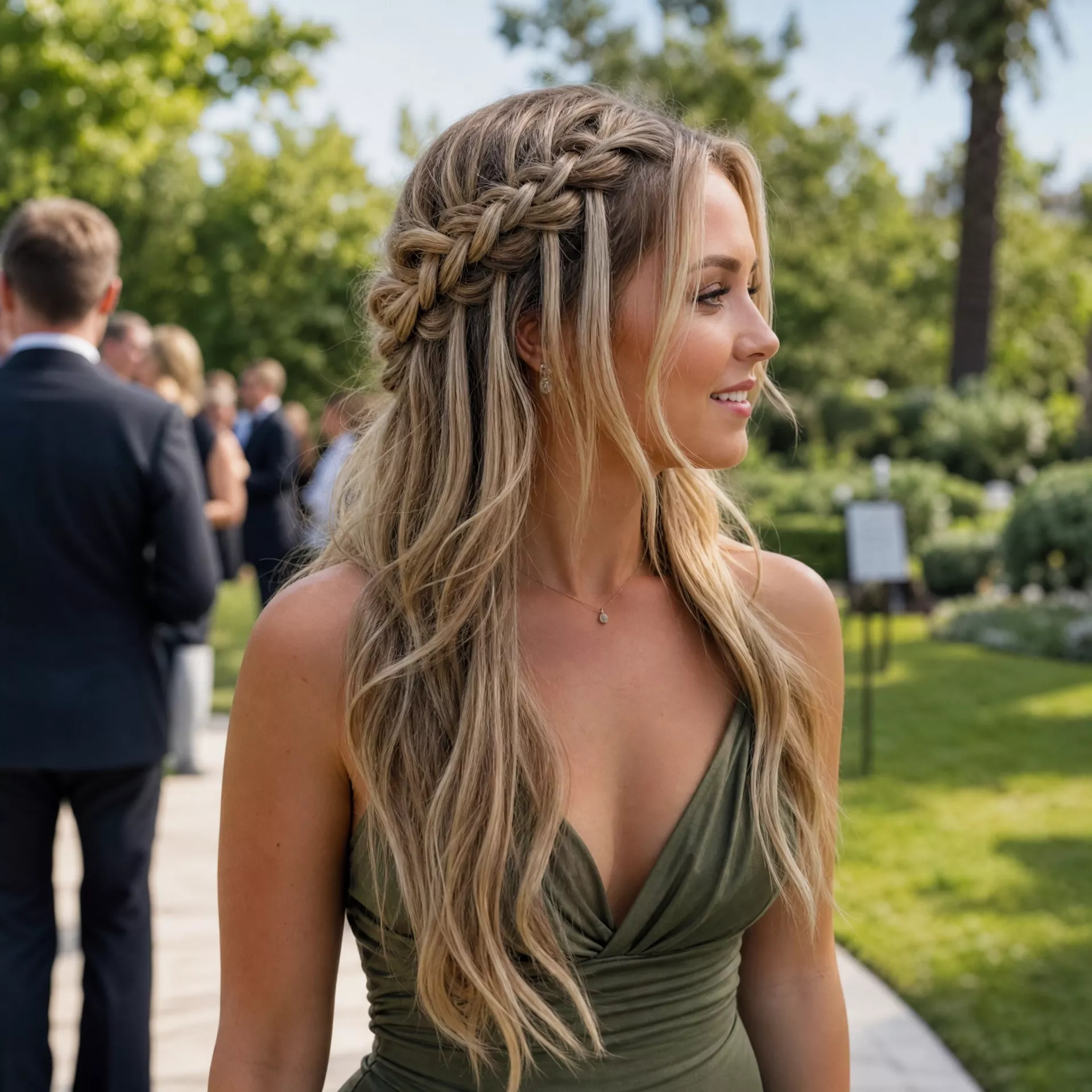
24 Wedding Guest Hairstyles for Shoulder Length Hair and How to Choose the Right One
A reference photo can make a wedding guest hairstyle look simple, but it leaves out most of what decides whether the style will work for you. It doesn’t show how much hair the model actually has, whether her waves are natural or made with a wand, or how many pins are holding the shape. It also can’t show how the style looks after a few hours of sitting, hugging, and dancing, or how it handles humidity, wind, and the neckline of the outfit.
Shoulder length hair can be styled many ways, but it also has limits. Curling shortens it, and some shapes need more length than a photo suggests. The 24 styles below run as one continuous list, and each points to the practical detail that matters most, whether that’s grip, weight, preparation, or what the style does with earrings and a neckline.
Half-Up with Loose Waves

Two separate things are happening in this style: a gathered top section and waves below it. The waves are the part to think about. Hair that already bends may hold a wave with a little product, while straight hair usually needs curling, and humidity can relax the waves during the day. Curling also shortens shoulder length hair, so the loose section may end closer to the jaw than it was when straight. Check where your hair lands once it’s curled, not where the reference model’s falls.
Low Chignon at the Nape

A low chignon sits close to the neck, so it keeps hair off the neck and puts the attention on earrings and necklines. It needs enough length to wrap and pin, which at shoulder length can mean a compact knot rather than the full, rounded one in many photos. Dense hair can make a sturdy shape that holds with firm pins. Fine or low-density hair may do better with a smaller, flatter knot. A pin placed in a firm section holds better than one slipped through loose hair.
Romantic Half-Up Twist

This one depends on grip. Twisted sections hold more readily on hair with some texture, while freshly washed, very smooth hair can slide out of its pins. If your hair is fine and slippery, a light texturizing product or an extra pin or two usually helps more than a tighter twist. The style leaves the lower lengths loose, so those sections will move and may need a quick adjustment after a hug or a gust of wind. It suits guests who want something with a little structure and not much preparation.
Sleek Low Ponytail

Sleekness is a finish, not a haircut, and how much work it takes depends on your texture. Straight hair may need little more than brushing and a smoothing product. Wavy or curly hair usually needs a blow-dry or straightening first, and humidity can undo it quickly. At shoulder length, the ponytail itself will be short, and wrapping a section around the elastic uses up some of that length. A small accessory placed over a hidden elastic gives a similar finish without using any hair.
Soft Braided Half-Up

Small braids from each temple, pinned together at the back, keep the front clear while the rest of the hair stays loose. They’re easier than a full braided style, but they still take some practice. On fine hair, the braids can look narrow, and loosening the edges gently gives them more width. Low-density hair may do better with smaller braids placed closer to the hairline. Secure the join firmly, because it’s the one part of the style that has to carry any accessory you add.
Textured Updo with Face-Framing Pieces

Texture is what makes a loose updo forgiving. Slightly rough, grippy hair pins more securely than smooth hair, and small shifts in the shape look intended instead of undone. The loose pieces at the front are the first thing to change as the day goes on, so decide in advance whether you’ll mind re-tucking them. Shoulder length hair can make a modest updo but may not reach every pin in a larger one, so plan for a smaller shape than the photo suggests.
Pinned-Back Waves with Floral Clip

The clip is both a decoration and the thing holding the style together, so it needs something to grip. A pin placed into a smooth section of fine hair may slide out, while a firmer anchor, like a twisted or lightly backcombed section, holds better. Pinning back one side exposes an ear and earring, which is worth considering if your jewelry is part of the outfit. In wind, the loose waves on the open side will move, and a light flexible hold works better than anything stiff.
Voluminous Blowout Worn Down

With no pins or braids, this style relies entirely on how long your hair holds its shape. Humidity, heat, and sitting in a car can all flatten a blowout, and how long it lasts varies a lot between hair types. At shoulder length, the ends often flip outward where they meet the shoulders, which may suit the style or work against it. If your hair holds a blowout better the day after washing, styling the night before and refreshing in the morning may suit you more than doing it all on the day.
French Braid Half-Up

A French braid picks up hair as it travels along the head, which anchors it to the scalp. That can make it a steadier choice for a day of moving around, though how well it holds depends on texture, preparation, and technique. Tension is the thing to check. A very tight braid can become uncomfortable after a few hours, and on thick or dense hair it may pull more. It also suits outdoor weddings where wind is likely, because the braided section stays put even when the loose lengths move.
Low Side Bun

Gathering hair low and to one side shifts the weight to that side, which is worth noticing on dense hair, where the bun can feel heavy. The open side shows the ear, neck, and earring, while the bun side shows the back of the head. If your outfit has detail at the shoulder or back, think about how the two relate. At shoulder length, a side bun is usually small and neat, and a few loose pieces around it can soften it without relying on extra length.
Twisted Side Updo

Sweeping everything to one side and twisting it needs more length than it looks, because the hair has to travel across the back of the head before it can be pinned. At shoulder length, shorter layers near the nape may refuse to reach and escape the twist. A stylist or a practice run can show whether your cut supports this shape or whether a smaller version suits better. It’s a style that rewards a rehearsal, since the pinning pattern matters more than the look of the twist itself.
Curled Half-Up with Bobby Pin Tuck

This is one of the more preparation-heavy styles on the list. The hair is curled, a section is gathered, and the ends are tucked and secured with pins, so there are several steps to get right. Curling shortens shoulder length hair, which means the tucked section may be smaller than the reference. Curls also relax over time, especially on fine or straight hair, and sitting in a car for a long drive can flatten them. It suits someone who has the time and doesn’t mind a touch-up.
Sleek Side Part Blowout

A deep side part works best when it follows your natural part. If it goes against your growth pattern, it may drift back toward the center during the day. Because the hair is worn down and smooth, it also falls forward when you look down at a table or a phone, so you may find yourself tucking it behind an ear. The look leaves the neckline and shoulders uncovered, which can suit a dress with structure at the neck or shoulders. There’s no accessory to hold the style, so its success depends on how well your hair stays smooth.
Braided Crown with Loose Ends

A crown braid has to reach across the head, so length is the main limit. At shoulder length, the braid may be shorter or thinner than in a photo, and curling the loose ends shortens the hair further. Curly and coily hair shrink as well, so a braid that looked long wet may sit much shorter dry. It tends to suit outdoor settings, but wind will move the loose section. If you add a flower or crystal pin, attach it to the braid itself rather than to loose hair.
Classic Half-Up Half-Down

This is one of the more adaptable styles on the list. It works with straight, wavy, curly, or coily hair, with the lower section left smooth, curled, or in its natural pattern. That flexibility makes it easy to adjust for the weather and your comfort. It also takes a clip or comb well if you want to add one. Because the lower section is free, it will move, so expect to adjust it now and then. If you want less fuss, wearing the lower section in its natural texture means there’s less to undo.
Low Bun with Wispy Pieces

A low bun keeps hair off the neck, which many people appreciate at a warm or outdoor wedding. The wispy pieces are the variable. In humid weather or after dancing, they can cling to the skin, frizz, or fall out of place. If you like the soft look, curl them lightly or smooth them with a little product. If you’d prefer to avoid constant tidying, leave fewer out. At shoulder length, the bun itself will be small, so the wispy pieces do a lot of the visual work.
Soft Waves with Center Part

A center part is symmetrical, so it shows any unevenness and works best when it matches your natural part. On lower-density hair, it can show more scalp along the line than a side part would. Wavy hair worn down is also at the mercy of wind and hugs, which will move it around. If your hair has natural wave, you may be able to work with it and add a little definition. If it’s straight, you’ll need to create the waves, which takes time and may not last as long in damp weather.
Dutch Braid Half-Up

A Dutch braid is made by crossing sections under rather than over, so it sits on top of the hair instead of blending into it. That raised look is the main difference from a French braid. On fine hair, loosening the edges gently can make it look wider, though it doesn’t add any hair. It’s usually easier after some practice, since the underhand technique feels unfamiliar at first. The rest of the hair can stay straight, wavy, or curled, depending on what you prefer.
Elegant Twisted Low Chignon

This is a more structured updo, with twisted sections gathered and pinned low. It can suit a formal dress code, but only if it feels natural to you, and a style you’ve never worn before is harder to carry off. It needs enough length for the twists to travel and pin, so shoulder length hair may produce a smaller shape. The back view matters, because it will be seen when you’re seated at a ceremony. Check how it looks against the back of your outfit.
Boho Messy Bun

Messy doesn’t mean there’s no technique. The base has to be secure, even if the outside looks loose, or the whole thing may slide down within hours. Hair with some texture holds a bun better than very smooth, freshly washed hair. At shoulder length, the bun will be small, and the loose pieces around it are what give it its relaxed look. A ribbon or small flower can add a finishing detail, as long as it has something firm to attach to.
Pinned Back Natural Curls

Natural curls shrink as they dry, so they’ll sit shorter and fuller than they look wet. Curl pattern, density, and humidity all affect how they behave, and a pattern that differs from the model’s will change the finished look. Many people prefer to use products they already know rather than try something new for the day. Pinning back one side keeps curls off the face, but the clip needs enough hold. Gather a small section for the clip to grip, rather than just a loose strand.
High Ponytail with Wrapped Elastic

A high ponytail pulls on the crown more than a low one, and at shoulder length the tail is short, so it may look smaller than expected. Dense hair holds a fuller shape but adds weight and tension. Fine or low-density hair may look slimmer at the base. Wrapping a section around the elastic hides it but uses up some length, and a short tail has less to spare. Because it pulls everything off the neck and shoulders, it also shows earrings, a necklace, and the neckline clearly.
Loose Side Fishtail Braid

A fishtail uses many narrow sections, so it needs more length than a regular braid, and at shoulder length it may be short. If you’re drawn to the style, ask whether your length supports it before you commit. The braid is also a detail that takes practice, so trying it beforehand makes sense. Pulling the braid slightly looser can make it look fuller, but a looser braid is less secure, so the elastic needs to be firm. Worn to one side, it shifts weight to that shoulder.
Half-Up with Pearl or Crystal Pins

The accessory is the point, but the pins add weight and need to be anchored. Place them through a firm, twisted, or lightly textured section rather than smooth hair, where they may slide. Fine hair may need hidden pins behind the decorative ones for extra support. Pearls and crystals can also catch on hair, so it’s worth checking how easily they come out. The style itself is simple, which leaves room for the accessories to do the work, but it also means they matter more.
Start With the Wedding, Then Your Hair
Before choosing a style, think about the setting. A garden or beach wedding may involve wind and humidity, which can loosen waves and pull wispy pieces out of place. A formal ballroom or evening wedding may call for more structure, though what feels appropriate also depends on personal style. A casual daytime wedding gives you more room to wear relaxed or natural styles.
Think about the time of day and how much you’ll be moving. A long reception with dancing asks more of a style than a short ceremony. Then think about the dress code and how much time you want to spend getting ready. None of these settings requires a particular style. They just change which trade-offs matter.
Shoulder Length Has One Important Limitation
The same reference photo can look different on shoulder length hair, because the amount of hair available for pinning varies. Density, texture, actual length, layering, and curl shrinkage all change how much you can gather. Curling shortens hair, and layered cuts may have shorter pieces that escape updos.
When a style needs more length than you have, a modified version is often smarter than trying to match the photo. That might mean a smaller bun, a shorter braid, or fewer curls. Sometimes it means hair pieces or added hair, though for a guest style that’s rarely necessary. Aim for the shape your hair can hold, not the exact photo.
Think About the Parts of the Outfit Your Hair Will Frame
Your hair and outfit share the same space, so they should work together. An updo exposes the neck and shoulders, which suits necklines that show them. Hair worn down covers some of the neck and can hide a detailed collar or back. Earrings are more visible with styles that pin hair back, and they can be hidden under hair worn down. A necklace may tangle in loose hair, so check how it sits.
If the back of your dress has detail, an updo shows it. Hats or fascinators need a stable base, usually a gathered section or a smooth area, so check how they work with your chosen style before the day.
The “Will I Have to Fix It?” Test
Before committing to a style, run through a few movements to see whether it will need fixing.
- Can you sit comfortably, including leaning back against a chair?
- Can you turn your head from side to side?
- Can you look down at a table or phone without hair falling forward?
- Does it survive a hug?
- Would it hold up if you danced?
- What happens when you walk outside in a breeze?
- Does it work with your earrings?
- Can you leave it alone for a while without touching it?
If a style fails several of these, it may not suit the event, however good it looks in a photo.
What to Do Before the Wedding
If a style is new to you, try it beforehand, so you know how long it takes and how it behaves. Avoid trying a completely new product on the wedding day, since hair can react differently to unfamiliar formulas. Gather the pins, clips, elastics, and accessories you’ll need, and bring a few spares.
Check the weather forecast and think about how humidity, wind, or heat might affect your hair. Decide whether you want freshly styled hair or hair prepared the night before, based on how yours normally holds a style. Some hair grips better on the second day, and some looks best freshly washed, so go with what your hair already does.
FAQ
What is the easiest wedding guest hairstyle for shoulder length hair?
A classic half-up, a low ponytail, or a low bun usually need the least preparation. How easy they are depends on your texture and how often you wear them.
Can shoulder length hair be put into an updo?
Yes. Low buns, chignons, and twisted styles often work well, though larger or more elaborate shapes may need more length than you have.
Should I wear my natural curls to a wedding?
You can. Natural curls, coils, and waves can look polished in their own pattern. Plan for shrinkage, and use products you already know.
How do I make a wedding guest hairstyle last?
Holding depends on texture, preparation, and pinning. Hair with some grip tends to hold more securely, and a flexible hold product may help more than a stiff one.
What hairstyle works best for an outdoor wedding?
Styles that are secure and low on loose pieces are easier to manage in wind, while relaxed styles can work if you’re comfortable with a little movement.
Should I practice a hairstyle before the wedding?
For anything unfamiliar, yes. A practice run shows you how long it takes and whether your hair supports it.
Final Thoughts
The right wedding guest hairstyle is the one that works with your hair as it is, suits the setting and your outfit, and stays comfortable through the event. It doesn’t need to be the most elaborate option. Choose how much effort you want to spend and what kind of upkeep you can live with, and let those answers guide your pick from the 24 styles above. A style that holds without much attention leaves you free to enjoy the day.