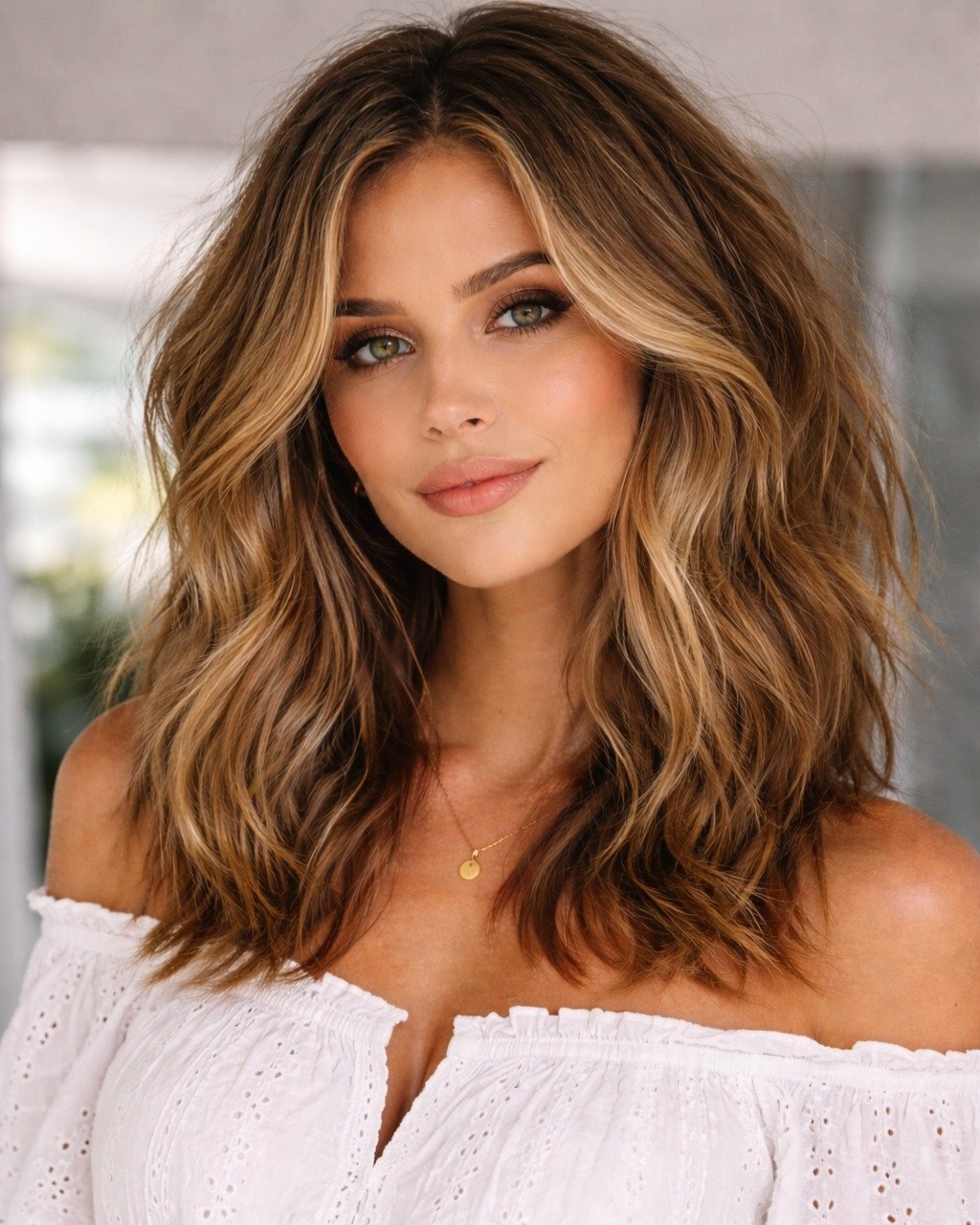
25 Hairstyles for Round Faces and How to Choose the Right One
A round face usually has softer curves along the cheeks and jaw, with width and length that sit fairly close to each other. That’s a useful starting point when you’re choosing a haircut, but it isn’t a rulebook. Two people with the same face shape can ask for the same cut and walk out with quite different results, because their hair behaves differently.
What you end up with depends on length, parting, where the layers and fringe sit, and how you style it, and just as much on the hair itself: its density, the thickness of each strand, and its natural texture. How much maintenance you’re willing to take on matters too.
It also helps to decide what “flattering” means to you. Some people want a longer visual line. Others want to show off their cheekbones, let their curls take up space, add some structure, keep their length, or simply spend less time styling. The 25 ideas below cover all of those directions.
Long Layers with Face-Framing Highlights

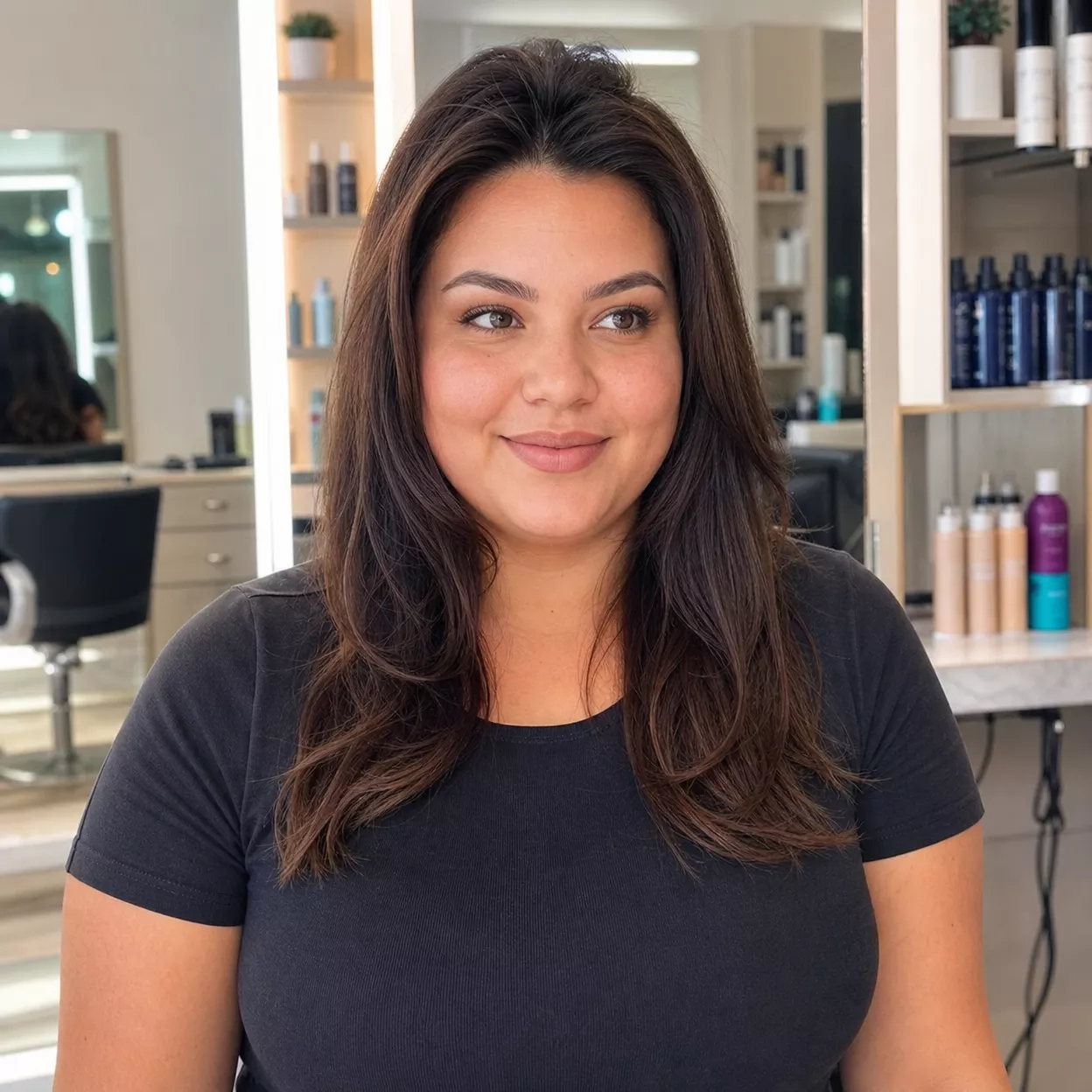
Two separate decisions are combined here. The layers are the haircut: longer lengths with shorter pieces near the face. The highlights are color placed around the front. Together they tend to pull attention toward the cheekbones and eyes, but where the shortest layer starts decides how strong that effect is. Starting at the cheekbone frames the face closely; starting near the jaw or collarbone keeps the front softer. On fine or low-density hair, face-framing layers need careful placement, because too many short pieces at the front can leave the lengths behind them looking sparse. The color can be added or skipped independently.
Deep Side Part with Loose Waves

Moving the part well off center sends more hair to one side and creates an asymmetrical line across the forehead. How well that holds depends on your natural part. If your hair already falls to one side, a deep part usually stays put; if you’re forcing it against the grain, it may drift back by midday. The loose waves can come from natural texture or from a wand, which makes a big difference to your morning. Humidity can loosen heat-made waves or make natural ones fuller than they were when you left the house.
Curtain Bangs with Medium Length Hair

Curtain bangs change the frame around the forehead and upper cheeks, with a center split that opens up the middle of the face. Their length decides the effect. Bangs ending around the cheekbones blend into medium-length layers, while shorter ones read more like a fringe. They sit most easily when the center part is close to where your hair naturally parts. On wavy or curly hair, the bangs can shrink and spring up as they dry, so it’s worth agreeing on their dry length first. They’ll need trims between full haircuts and a minute with a brush or dryer on most days.
Sleek High Ponytail

This is a styling option rather than a haircut, so the real questions are length and comfort. A high ponytail lifts hair away from the sides and moves the visual weight upward, and the height you choose changes how pronounced that is. It needs enough length to reach the crown. On fine or low-density hair, the tail itself can look slim, so some people wrap it loosely or pin a few pieces for fullness. Getting it sleek usually means brushing and a smoothing product, flyaways are common in humidity, and a very tight ponytail worn daily can be uncomfortable, so a slightly looser version is often easier on the scalp.
Textured Lob with Side Part

A lob’s effect depends a lot on where it ends. At the jaw, the perimeter sits right at the lower face and draws attention there. Just below the jaw, it frames the chin without stopping on it. Near the collarbone, the shape becomes longer and more relaxed. Texture, whether natural wave or a bend added with a wand or flat iron, keeps the perimeter from looking heavy, and a side part adds some asymmetry. If your hair is straight and you don’t want to style it daily, ask how the lob will look air-dried, since the texture in most photos is created.
Voluminous Blowout with Center Part

The shape in these photos is largely a styling result. A round-brush blowout can put lift at the crown while keeping the sides smoother, which moves the visual emphasis upward. The same technique can just as easily add width at the sides if the lift goes there, so where the volume lands is decided by how the hair is dried. Naturally straight hair usually holds a blowout more predictably. Wavy, curly, or very dense hair can take considerably longer to dry and smooth, and humidity may undo the result sooner. Treat this as a look you create, not one a haircut gives you on its own.
Beachy Waves on Long Hair

Long hair gives waves room to fall, so the movement runs down past the face rather than gathering around it. That texture might be natural, or it might come from a curling iron or wand. If your hair already dries with a loose bend, the look can be quick; if it dries straight, expect to recreate the waves most days. Length brings its own trade-offs. Long hair can take a while to air-dry, and the weight can pull waves looser near the top. Air-dried and heat-styled versions often look quite different, so check which one your reference photo actually shows.
Pixie Cut with Volume on Top

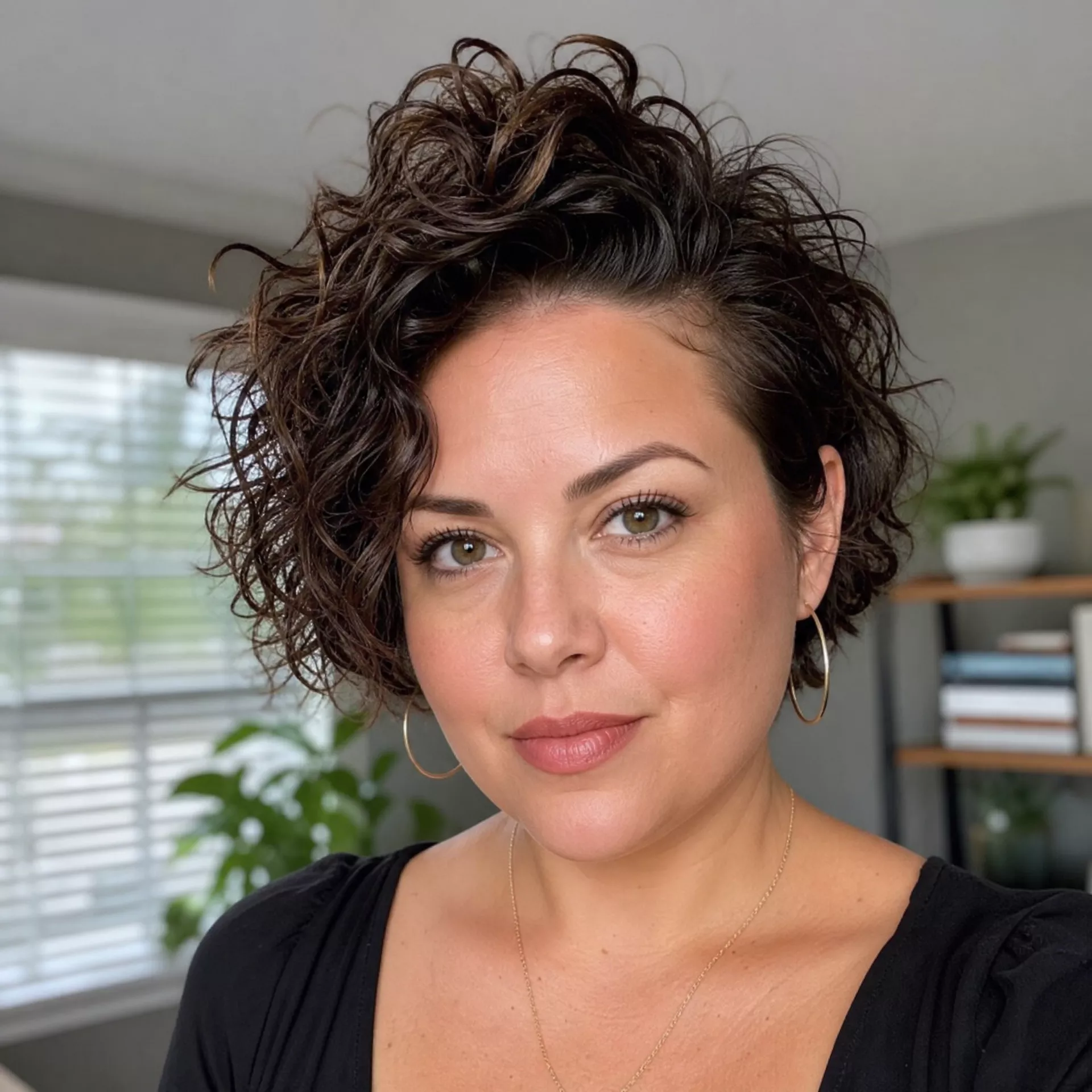
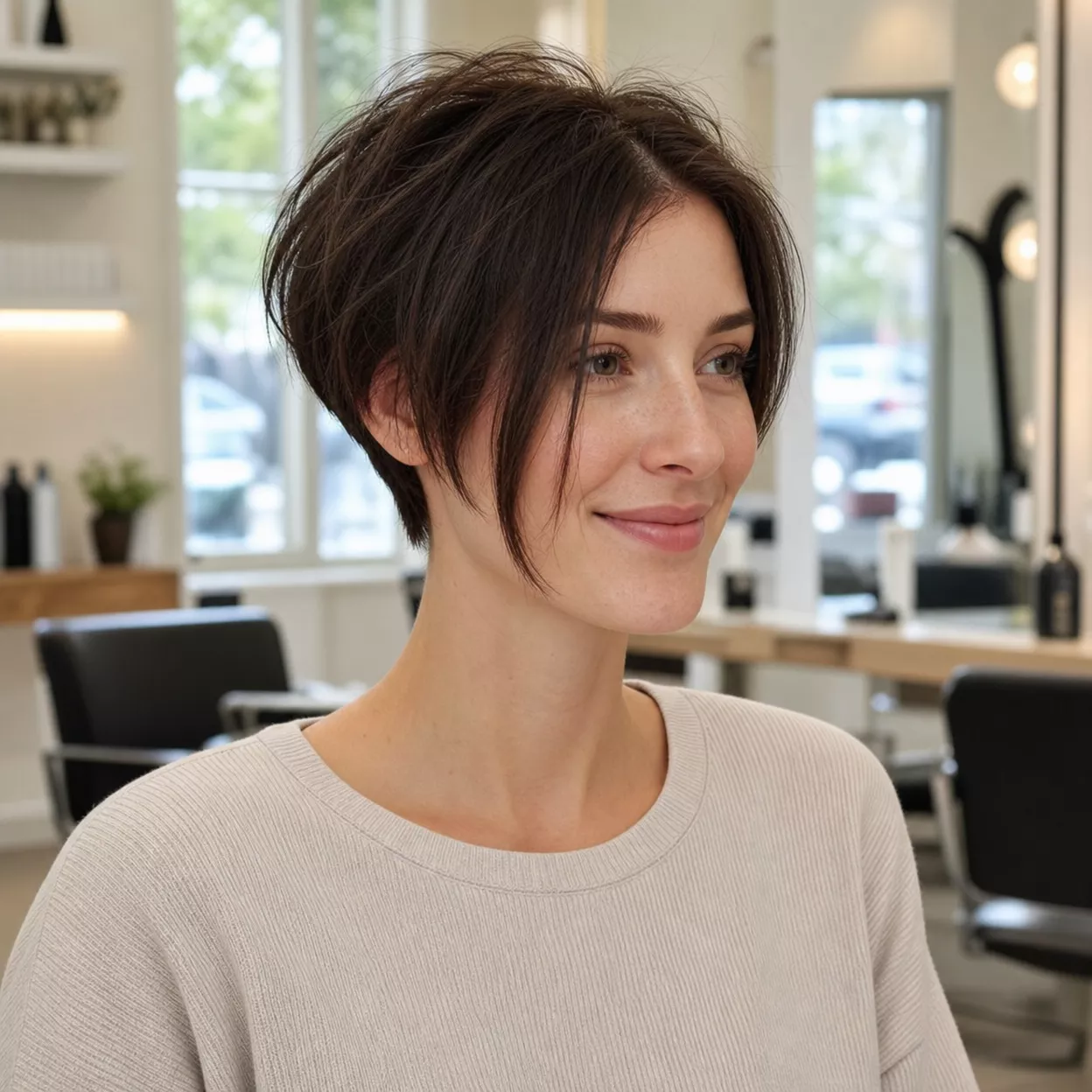
A pixie changes everything at once: the sides and nape are short, and the crown carries most of the shape. Leaving some length and lift on top can shift attention upward, though whether you want that is a preference rather than a requirement. Results vary with hair type. Fine but dense hair often holds a lifted top well. Low-density hair may show more scalp if the top is cut very short, so keeping a little extra length there can help. Thick hair may need weight taken out so the sides don’t push outward. Expect a small amount of product each day and regular reshaping, since short shapes show growth quickly.
Layered V-Cut on Long Hair

A V-cut shapes the back perimeter into a point, so the hair is longest at the center back and shorter toward the sides. With layers throughout, it creates a downward, tapering outline from behind. The trade-off is at the ends. A point holds less hair at the bottom than a straight perimeter, which rarely matters on dense hair but can make low-density hair look thin at the tip. A shallow V keeps more weight than a sharp one and grows out more evenly. It’s worth deciding whether you actually like that tapered look from behind before asking for it.
Soft Updo with Loose Tendrils

This styling technique gathers hair loosely and leaves a few pieces free around the face. The height of the updo and the length of the tendrils both change the result. A higher updo lifts the overall shape, tendrils ending near the jaw frame the lower face, and tendrils ending near the collarbone fall past it. Hair with some texture or second-day grip holds pins more easily; very slippery hair may need a little texture spray first. It needs enough length to gather. Looser versions suit casual days, while smoother, more structured ones suit formal events.
Straight and Sleek with Center Part

A center part creates a clean vertical line, and straight hair falling past the collarbone keeps the outline close to the face. How much work that takes depends on your texture. Naturally straight hair may only need a brush and a light smoothing product. Wavy or curly hair usually needs a blow-dry or flat iron, which changes the maintenance level entirely. Humidity can lift smooth hair and bring back frizz, and a center part makes any flatness at the crown obvious. If the crown lies flatter than you’d like, a little root lift before smoothing can help.
High Bun with Face-Framing Pieces

A high bun moves the weight of your hair to the top of the head. Placement changes the look: a bun right at the crown gives more height, while one sitting slightly lower reads as softer. On fine or low-density hair, the bun may look smaller than in photos, so some people wrap it more loosely or use a bun form to add size. Face-framing pieces soften the front, though short layers may slip out on their own anyway. Flyaways are common, and a very tight bun worn every day can pull at the hairline, so leaving a little slack is worth it.
Long Bob with Inward Curl

Turning the ends of a long bob inward gives the perimeter a closed, rounded curve that sits toward the face instead of flaring away from it. A few people’s hair bends that way naturally; far more often it comes from a round brush or a large curling iron. That makes it a styling-dependent look for most. It usually holds best on straight or slightly wavy hair with some density behind it. On fine hair, the curl may relax by the afternoon, and on thick hair, the ends may need some weight removed so they curve rather than bulk out.
Wispy Fringe with Long Layers

A wispy fringe is cut light enough for the forehead to show through, and it blends into long layers instead of forming a heavy line. That lightness needs enough density at the hairline; if the front is sparse, the fringe can look gappy, so starting a little heavier than the photo is sensible. Texture changes it too. Straight hair shows every strand, while wavy hair can make the fringe separate or kick upward. Fringes reach the eyes quickly, so plan on trims between haircuts. If you decide to grow it out, the long layers give it somewhere to blend.
Half Up Half Down with Volume at Crown

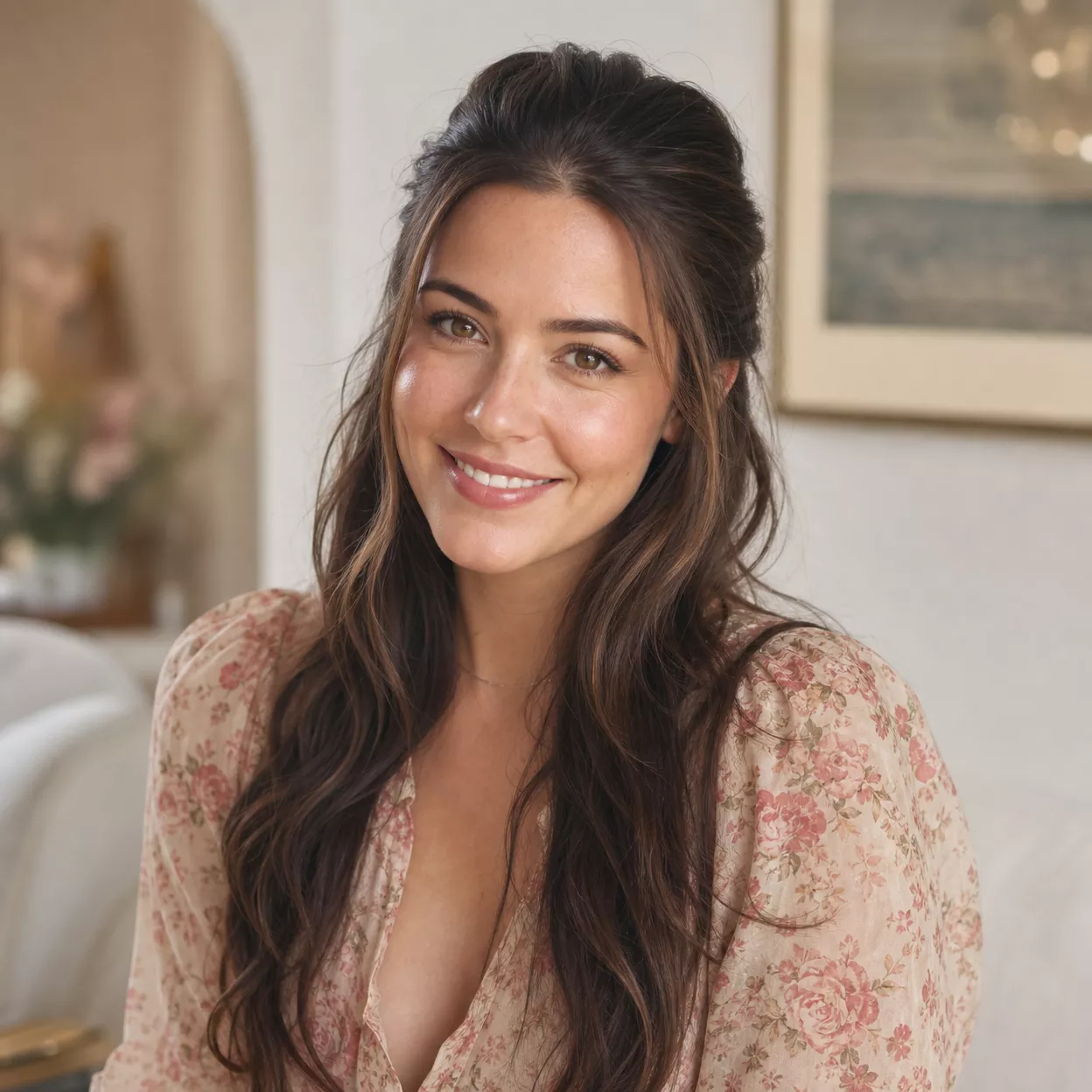
This sits between wearing your hair down and pulling it up. The top section is lifted and secured at the crown, adding height there while the rest keeps its length. It works best on medium to long hair. A little backcombing or texture spray at the roots gives the top section grip and lift, which helps on fine or slippery hair. On low-density hair, lifting too much can open up the part and show more scalp, so a smaller top section can look fuller. A couple of pins or a small clip usually hold more securely than a single elastic.
Side Swept Hair with Deep Side Part

Where the deep part with waves relies on texture for movement, this look is about the sweep itself: most of the hair travels across the forehead and down one side in a diagonal line. Direction matters. Hair swept the way your part naturally falls holds far better than hair pushed the other way. Straight hair usually needs a blow-dry to hold the sweep, wavy hair often keeps it more easily, and curly hair may settle into a looser version. A light hold product can keep it in place without making it stiff.
Layered Shag with Curtain Bangs

A shag uses layers at several lengths, often shortest around the crown and face, and curtain bangs carry that layering into the front. The combination puts texture and movement close to the face, and it behaves very differently depending on your hair. Wavy hair often dries into the shag shape with little help. Curly hair can look fuller and rounder, and the bangs may shrink noticeably. Straight hair usually needs product or heat to show the layers at all. Density matters as well: on low-density hair, heavy shag layering can leave the ends looking thin, so a softer version is worth discussing.
Tight Curls Stretched with Length

Tight curls can shrink significantly as they dry, so the length you see when your hair is wet may be far from the length you actually wear. Keeping more length lets the curls hang a little rather than stacking entirely around the head, which shifts the silhouette from round toward a longer oval, if that’s the shape you want. Density shapes the result. Dense curls can grow wide at the bottom if weight isn’t distributed well, while lower-density curls may need weight kept at the ends. Because curls change shape as they dry, your stylist may want to assess the natural dry pattern before settling on length and layers. Our guide to curly shag haircuts goes further into curl weight and shrinkage.
Slicked Back Low Bun

Pulling everything away from the face into a bun at the nape keeps the silhouette close to the head and puts the focus on your features. It’s a styling choice that depends heavily on texture. Straight hair smooths back easily with a gel or cream; wavy and curly hair can be slicked too, but usually needs more product and more brushing. There’s a balance between tight enough for a clean finish and loose enough to avoid tension, especially if you wear it often. Baby hairs at the hairline can be smoothed down or left soft.
Braided Crown with Long Loose Ends

Sections are braided across the top of the head while the rest of the hair falls loose below. The braid adds structure and some height at the crown, and the loose lengths keep hair around the shoulders. It needs enough length for the braid to reach across. Hair with some grip holds the braid better than freshly washed, slippery hair, which may need texture spray or extra pins. Humidity can loosen the braid over the day, and the loose ends may frizz or wave more than they did in the morning.
Asymmetrical Bob

An asymmetrical bob is cut longer on one side, so the perimeter slopes across the jaw and creates directional movement a symmetrical bob doesn’t have. Where the lengths land matters. A longer side ending below the jaw keeps the shape softer, while both sides close to the jaw makes a sharper, more graphic look. The shorter side needs enough density not to look thin. Curly texture tends to blur the asymmetry, while straight hair shows it clearly. It also needs regular trims, since the two sides grow out unevenly. Our guide to bob hairstyles covers other perimeter shapes if you’d prefer something less angular.
Long Straight Hair with Layers and Curtain Bangs

Three separate elements work together here. The length keeps hair falling well past the face. The layers break that length up so it moves instead of hanging as one sheet. The curtain bangs add a frame at the front. On straight hair, each piece asks for a little styling: the bangs usually need a brush or dryer to sweep open, the layers may need a round brush to show movement, and long straight hair can look flat at the root without some lift. If you’d rather air-dry, ask your stylist to keep the layers and bangs long enough to fall into place on their own.
Textured Updo with Loose Pieces

A textured updo depends on grip. Second-day hair or a texture spray gives the sections something to hold onto, and pins are placed loosely so the shape looks relaxed rather than tight. The loose pieces around the face and nape are part of the design, not accidents. It needs enough length to gather and pin. Straight, silky hair may slide out without some preparation, while wavy or curly hair often holds it naturally. Humidity can add frizz, which suits the texture, but it can also loosen pinned sections, so a light hold spray helps.
Waterfall Braid on Medium Length Hair

A waterfall braid runs diagonally across the side or back of the head, letting a strand drop from the braid at each step so pieces fall through it. It needs at least medium length, enough for the braid to travel across and be pinned. Hair with some texture grips better; fine or slippery hair can loosen quickly. Once you know a basic three-strand braid, it’s more manageable than it looks, because you’re only dropping and picking up one section at a time. Braiding along the side of your own head still takes practice the first few times.
Voluminous Blowout on Natural Hair

Volume on natural or textured hair can come from two different directions. A blowout uses heat and a round brush or comb attachment to stretch and lift the hair, creating height and length. Alternatively, the volume can come from your natural curl or coil pattern, shaped with a pick or a diffuser. A blowout takes time, particularly on dense hair, and humidity can bring shrinkage back quickly. Regular heat also means planning for heat protection. Whether the volume sits at the crown or evenly around the head is a styling decision that changes the whole silhouette.
What Actually Changes the Result on a Round Face?
Face shape tells you where your features sit, but it doesn’t decide how a haircut will look. Several other things do most of that work.
Length changes where the hair stops relative to your face. A cut that ends at the jaw draws attention there, while hair ending well below the chin moves the eye downward past it.
The perimeter, meaning the bottom edge, affects how solid the ends look. A blunt edge reads as strong and defined; a soft or tapered edge reads lighter and moves more.
Layers decide where movement and fullness appear. Short layers near the cheekbones frame the face closely. Longer layers starting lower keep the front calmer.
Parting shifts the balance of the whole style. A center part creates symmetry and a straight vertical line. A side part adds asymmetry and sends more hair to one side.
Fringe changes the upper frame. Curtain bangs open the middle of the face, a wispy fringe softens the forehead, and a heavier fringe adds a horizontal line.
Texture and density change everything above. The same layers can look full on dense hair and sparse on low-density hair, smooth on straight hair and rounded on curly hair.
Styling, finally, is often what you see in a photo more than the cut itself. Blowouts, waves, and sleek finishes change the shape dramatically, and they need to be recreated every time.
Choose Based on Your Hair, Not Just Your Face Shape
If your strands are fine but you have plenty of them, you usually have room to experiment with layers and face-framing pieces without the ends looking thin. The layered cuts and shags on this list can work well, as long as the perimeter keeps some weight.
If your hair is fine and low-density, that weight at the perimeter matters more. Blunter shapes, longer layers, and fewer short pieces around the face tend to keep the hair looking fuller. Updos and ponytails may look smaller than in photos, so looser versions often suit better. Our guide to volumizing hairstyles for fine or thin hair covers that distinction in more depth.
Thick hair often benefits from internal weight removal so it doesn’t expand outward at the sides. Asymmetrical bobs, textured lobs, and long layers can all work, provided the stylist thins the interior rather than just shortening the ends.
Straight hair shows layers, parts, and perimeters clearly, which suits sleek looks, asymmetry, and blunt shapes. It’s also the texture most likely to need heat to create waves or volume.
Wavy hair tends to cooperate with shags, textured lobs, and loose layers, often drying into shape without much effort. Humidity may make it fuller or frizzier depending on the day.
Curly and coily hair benefit from cuts designed around the natural pattern. Length, shrinkage, and weight distribution matter more than any face-shape guideline, and the dry shape is the one to plan around.
If you rarely use heat, prioritize cuts that look finished air-dried on your texture. If you blow-dry most days, polished styles like the inward-curl bob or the voluminous blowout become more realistic.
When a Hairstyle That Looks Great in a Photo May Not Work the Same Way
Most hairstyle photos show hair at its most styled. A professional blowout, careful curling, and finishing products can create volume and shape that a haircut alone won’t reproduce at home.
Some photos also include extensions, which add length and density that aren’t visible in the image. Waves are often created with heat rather than natural texture, and studio lighting can make color and shine look more even than they would in daylight.
The model’s hair itself may be very different from yours. Density, strand thickness, natural texture, and growth patterns such as a strong cowlick or a particular part direction all affect how the same cut sits.
That’s why a reference photo works best as a starting point rather than a blueprint. Look for the specific element you like, whether that’s the length, the layers, the fringe, or the part, and ask how it would translate to your hair.
What to Ask Your Stylist
- Where should the shortest face-framing layer start on my hair?
- How much weight should stay around my perimeter?
- Will this shape work with my natural texture, or will it need styling every day?
- How will this cut look without a blowout?
- What happens as the bangs grow out?
- Would this amount of layering make my ends look thinner?
- Does this reference photo depend on heat styling or extensions?
- How should the shape change if I want to wear my hair naturally most days?
FAQ
What haircut works well for a round face?
Many cuts can work. The better choice depends on what you want the shape to do, whether that’s adding a longer line, framing the cheekbones, or showing off natural texture, combined with your density and how much styling you’ll do. Layered cuts, lobs, and side-parted styles are common starting points, but they aren’t the only options.
Are bangs suitable for round faces?
They can be. Curtain bangs and wispy fringes open or soften the frame around the forehead, while heavier fringes add a horizontal line. Your hairline density, texture, and willingness to trim them regularly usually matter more than face shape.
Is a bob suitable for a round face?
Yes. Where the bob ends makes the biggest difference. A bob ending just below the jaw or near the collarbone sits differently from one ending right at the jaw, and asymmetry or texture can change the look further.
Is long hair better than short hair for a round face?
Neither is automatically better. Long hair can create a longer visual line, while short cuts like pixies put the focus on your features. The right length depends on your preferences, your texture, and how much maintenance you want.
Can curly hair work with a round face?
Absolutely. Curly hair works best with a cut designed around its natural dry shape. Length, shrinkage, and how weight is distributed will shape the silhouette more than any face-shape rule.
Is a middle part suitable for a round face?
It can be. A center part creates symmetry and a vertical line, while a side part adds asymmetry. Your natural part direction and crown shape often decide which one sits more comfortably.
How do I choose from reference photos?
Pick photos where the hair texture and density look similar to yours, then identify the specific detail you like. Ask your stylist how that element would work on your hair rather than asking for an exact copy.
Final Thoughts
Face shape can help narrow the options, but it rarely decides the outcome on its own. The better choice comes from combining it with how your hair actually behaves, the silhouette you want, your density and texture, how you style your hair day to day, and how much upkeep you’re comfortable with.
Before your next appointment, choose one or two ideas from this list and decide which single detail matters most to you. That’s the part worth building the cut around.