22 Long Gray Hair Styles Worth Considering (And How to Tell Which One Suits You)
Growing out gray, or wearing it long on purpose, is a different project than most hair guides admit. Long hair shows every choice you make: the cut, the tone, how much heat you use, whether the ends are healthy. Gray adds another layer, because silver and white strands behave differently from pigmented hair. They tend to be coarser, more porous, and quicker to pick up yellow from sun, water, and product buildup.
So this is not just 22 pretty pictures. For each style below you get the honest version: who it flatters, where it falls apart, and what to actually say at the salon. After the styles there is a section on choosing by hair type and face shape, a care routine that fits gray specifically, a plain-language breakdown of the color techniques, real US price ranges from 2026 salon data, and a short FAQ. Skim the comparison table first if you just want a shortlist.
A Fast Way to Narrow It Down
| Style | Suits | Effort | Feel |
|---|---|---|---|
| Curtain bangs | Medium to thick hair, most face shapes | Medium (bang trims add up) | Soft, framed |
| Beach waves | Hair with some natural wave | Low | Relaxed |
| Sleek and straight | Straight or easily smoothed hair | Medium | Sharp, editorial |
| Voluminous blowout | Fine hair that needs body | High | Polished |
| Root shadow | Anyone mid-transition | Low | Blended |
| Balayage | Hair that reads flat | Medium | Dimensional |
| Long bob with layers | People who want less upkeep | Low | Easy |
| Loose updo | Events | Per occasion | Elegant |
The Styles
Long Silver Gray with Curtain Bangs
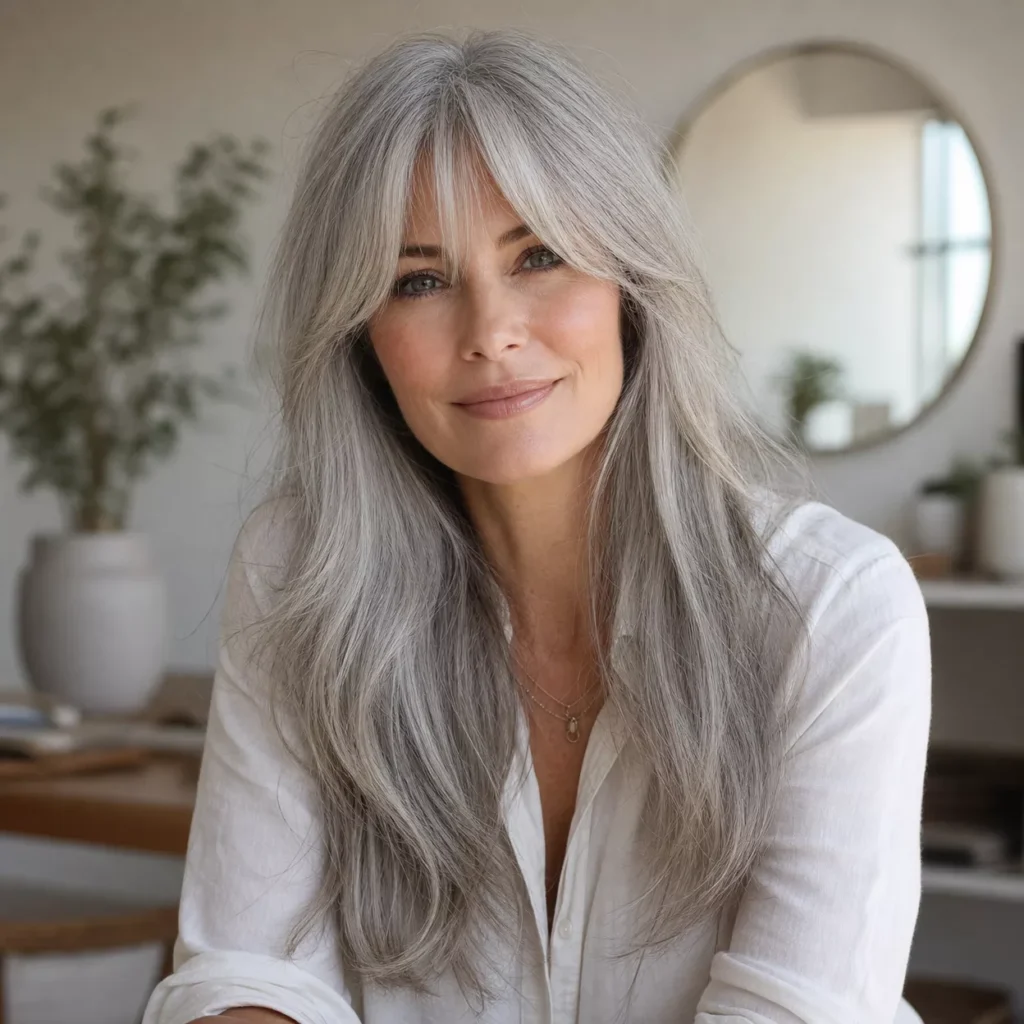
The reason this one is everywhere is that curtain bangs solve a specific problem: long gray, worn plain, can pull the face down and read severe. The parted, cheekbone-length pieces put softness back at the front.
It works best on medium to thick hair. On fine hair, be careful. Thin curtain bangs can look wispy rather than lush, and the weight of the length can flatten everything. If your hair is fine and you love this look, ask your stylist to build a few layers through the crown first so the shape has some lift to sit on. Budget for a bang trim every three to four weeks, or they lose the shape fast.
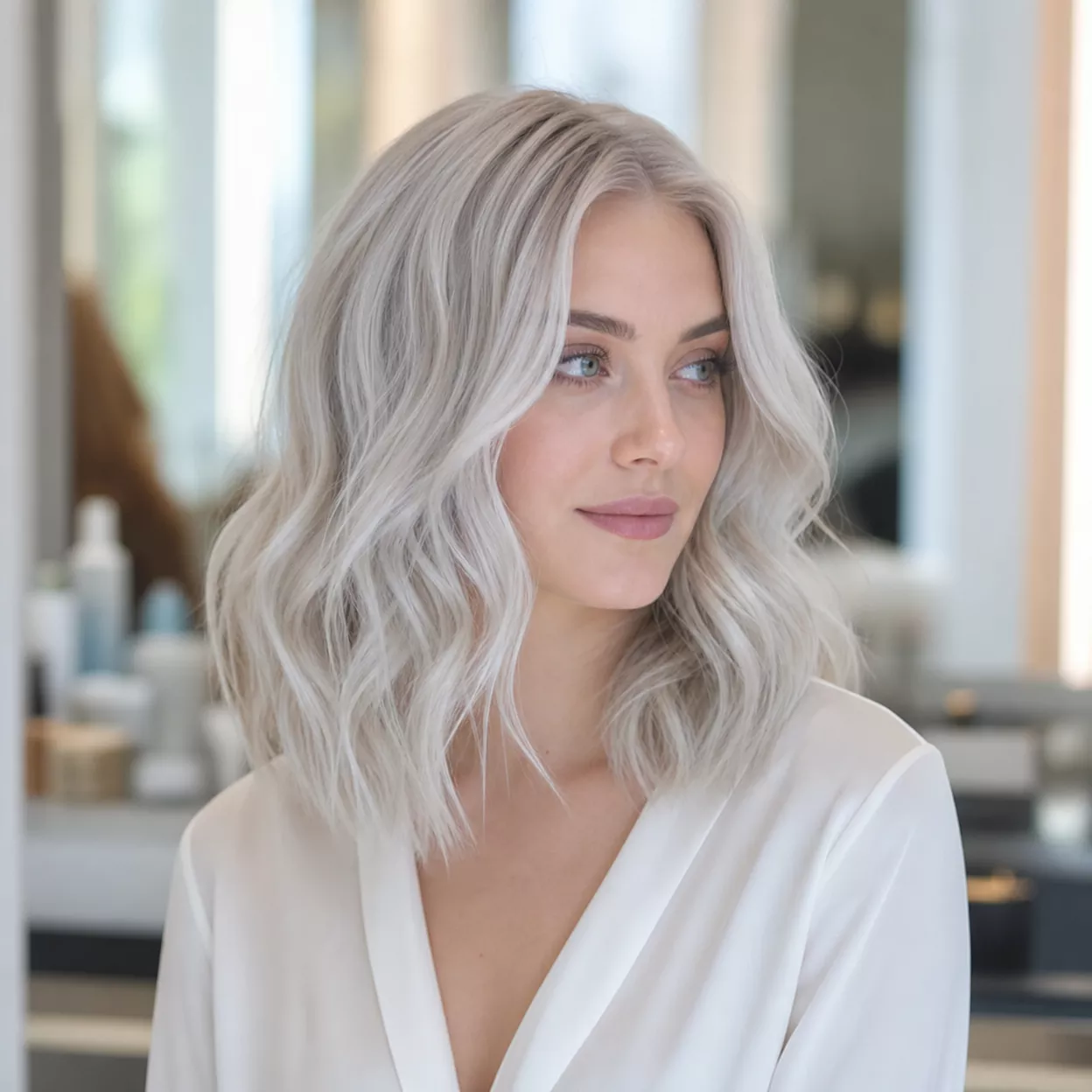
Long Gray Layers with Beach Waves
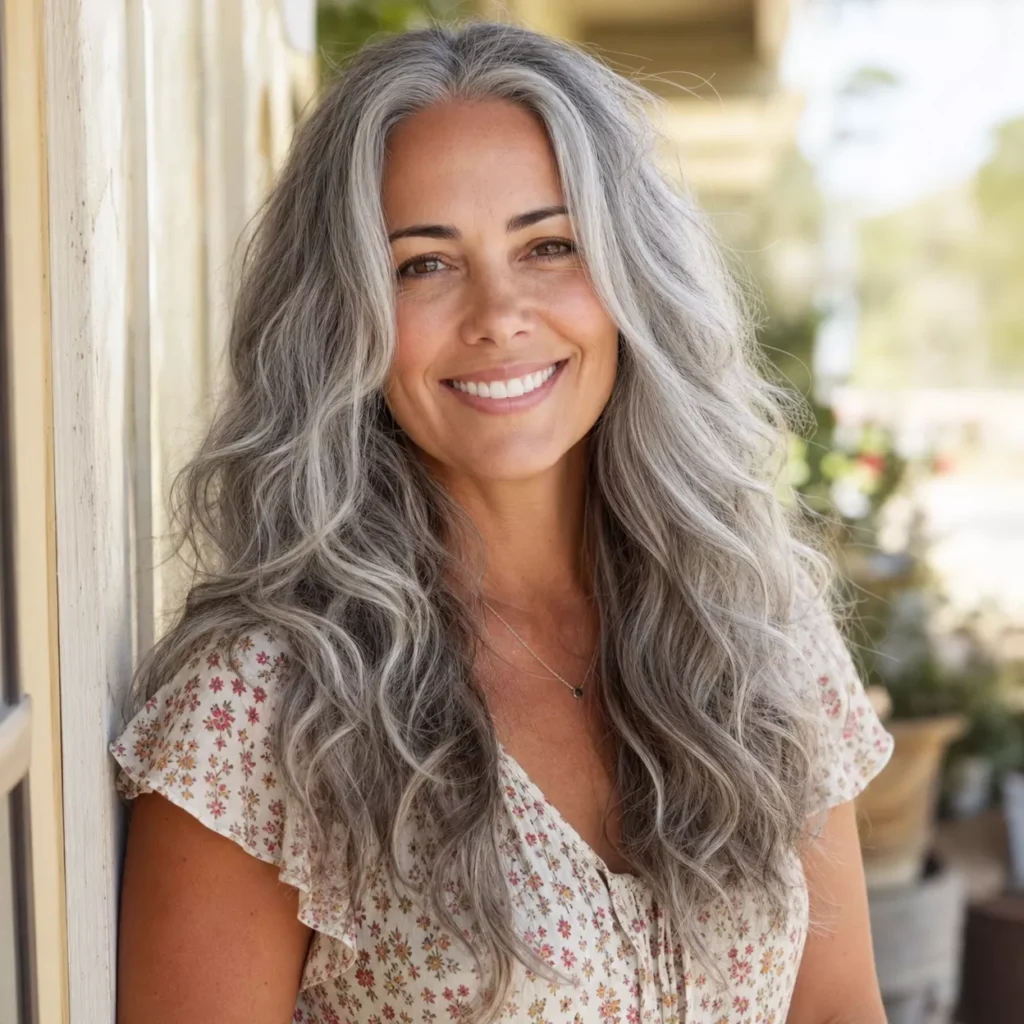
This is the low-effort favorite, and it earns it. Long layers plus a loose wave gives movement that plain length can’t, and gray tones actually catch light better when the hair bends. Scrunch a curl cream through damp hair, air-dry, done in about five minutes of hands-on time.
The catch: it needs some natural texture to hold. Poker-straight hair will drop the wave by lunchtime unless you set it with a curling wand and hairspray, which turns a five-minute style into a twenty-minute one. If your hair is stubbornly straight, this is more work than it looks.
A Full Blowout With Volume
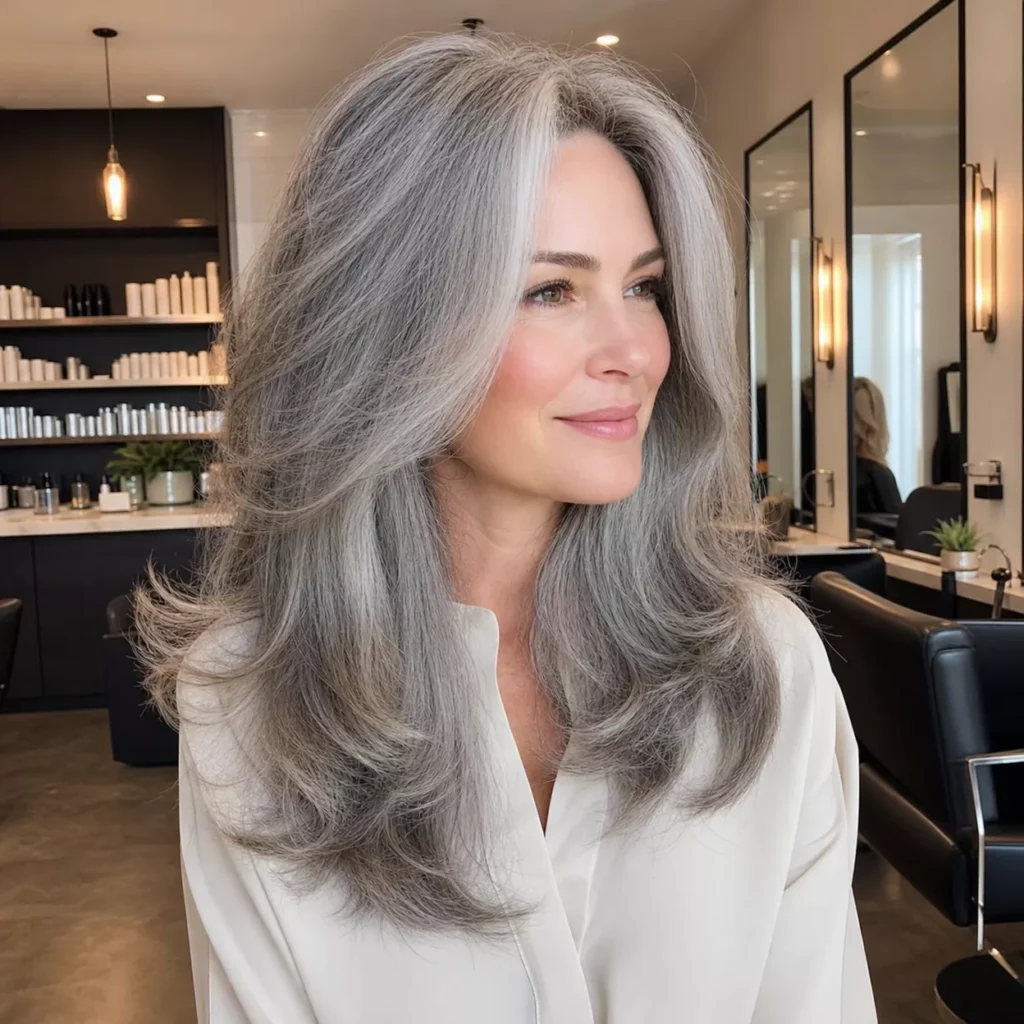
If your gray is fine or sits flat, a rounded blowout is the fastest way to fake density. Drying the ends outward instead of tucking them under builds a soft, full shape, and a boar-bristle brush gets the glossiest finish.
Honesty check: this is the highest-maintenance look on the list. A good blowout lasts a few days at best, and holding it means dry shampoo, careful sleeping, and staying out of humidity. Rain undoes it. If you don’t enjoy styling, skip this or save it for occasions.
Face-Framing Highlights
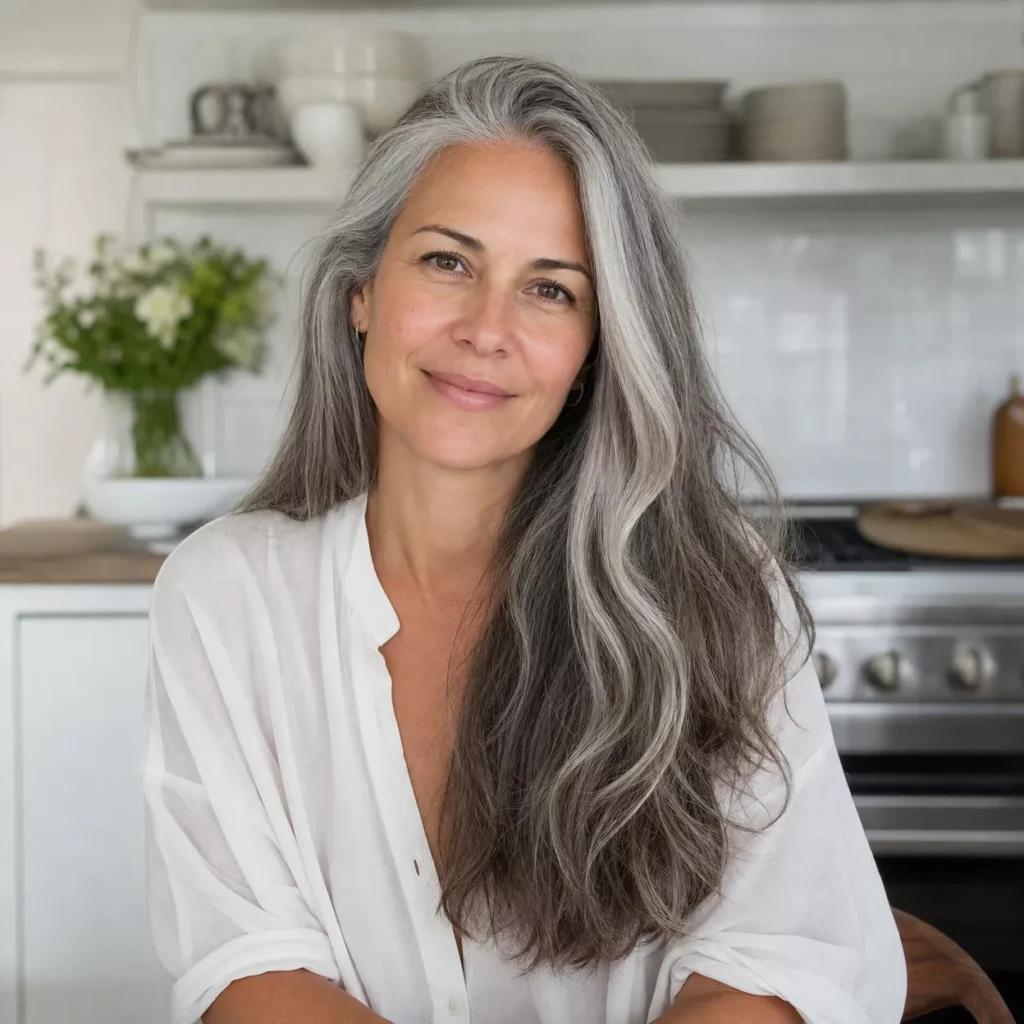
A few brighter pieces around the face lift the features and add contrast against a deeper gray base. Silver, white, or icy blonde blend most naturally. Because the color is concentrated at the front, the grow-out is gentle, so you can stretch refreshes to every eight to twelve weeks.
One thing colorists will tell you: naturally gray hair can be resistant to lightener, especially coarse white strands, so results vary and sometimes need a second pass. Talk it through at a consultation before you book the full service.
Long and Wavy, Left Natural
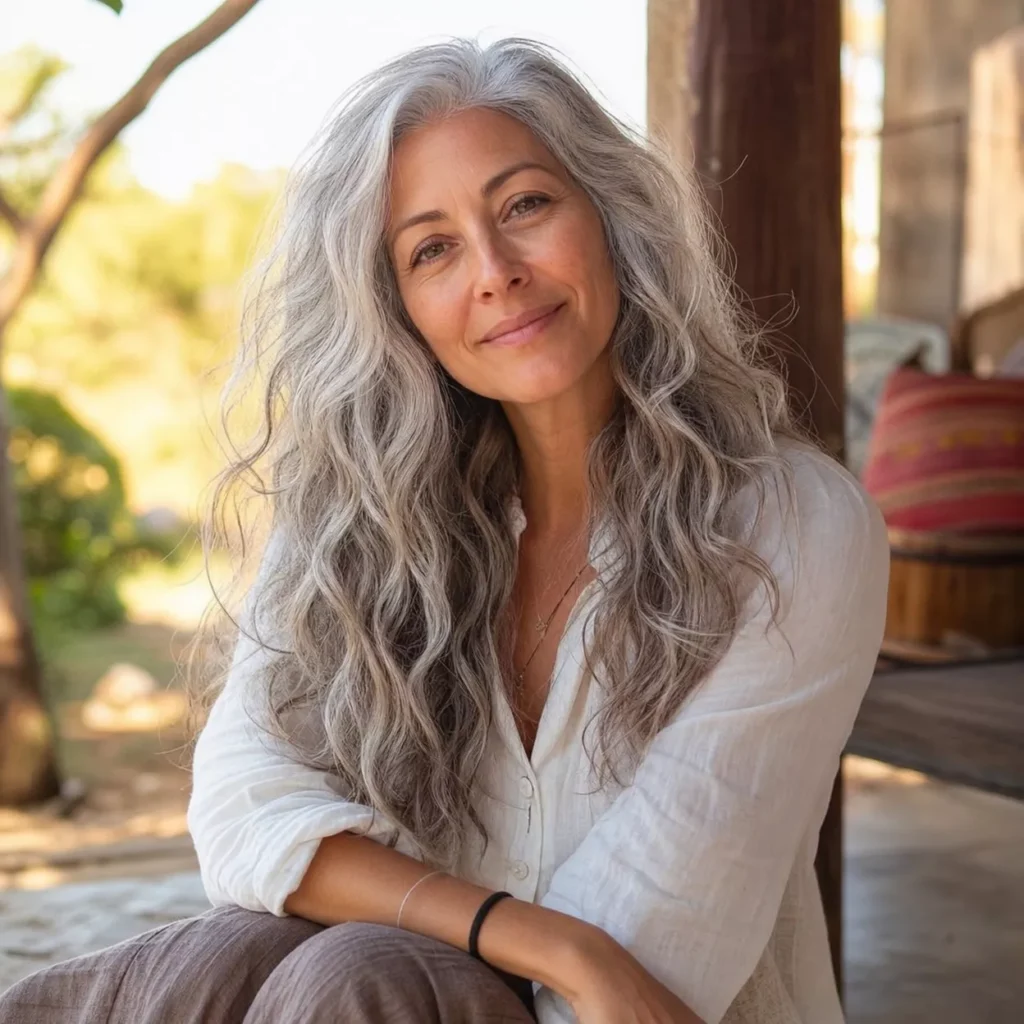
If your hair already waves on its own, this may be the easiest beautiful option you have. Wash, scrunch, air-dry, and let the texture do the work. The wave keeps gray from looking one-note.
This is genuinely texture-dependent, though. It rewards natural movement and does very little for hair that dries straight and flat. Don’t chase it if your hair won’t hold a bend without heat.
Curtain Bangs Plus Long Layers
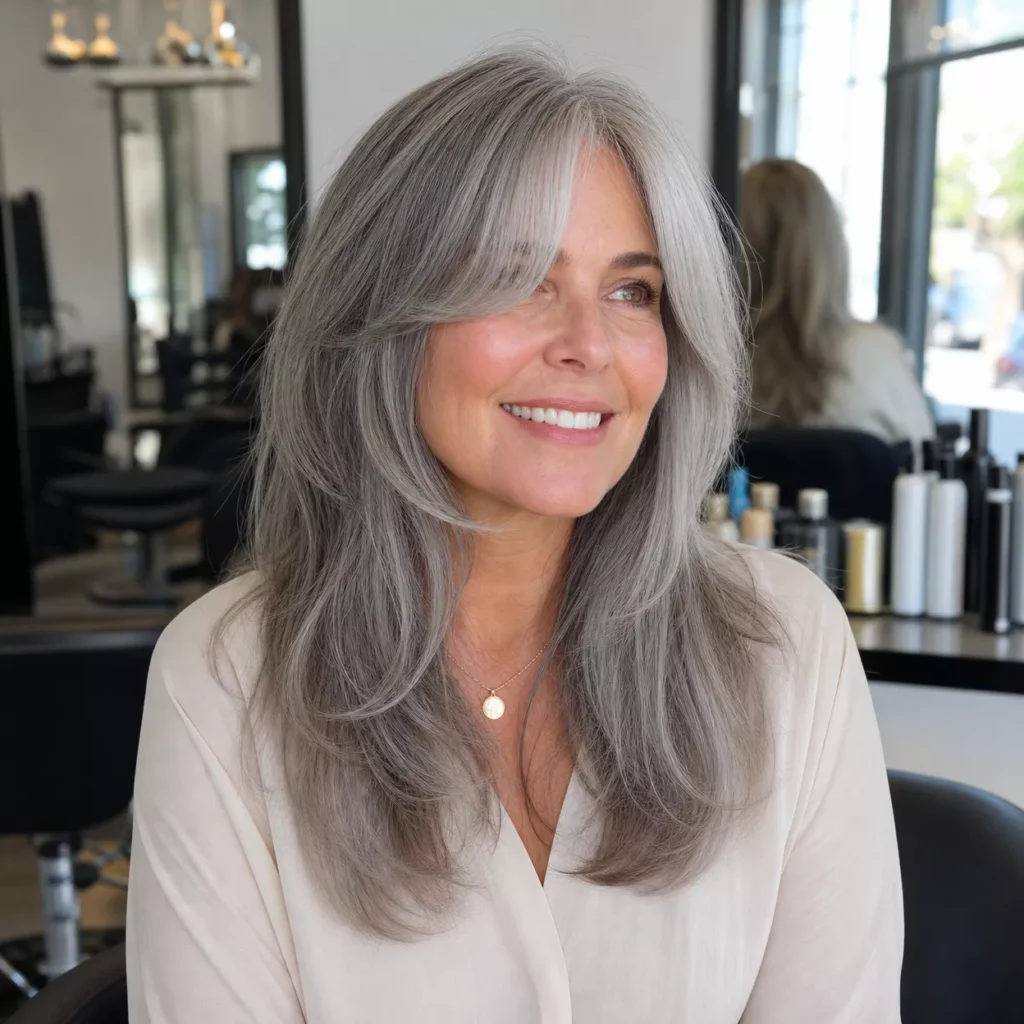
Bangs and layers together cover face framing, volume, and movement in one cut, which is why stylists reach for this combination so often. The bangs add width at the forehead; the layers keep the length from going heavy.
It suits medium to thick hair best. As with any curtain-bang look, fine hair needs extra internal layering to avoid a flat, stringy result, and you’re committing to regular bang trims either way.
Sleek and Straight
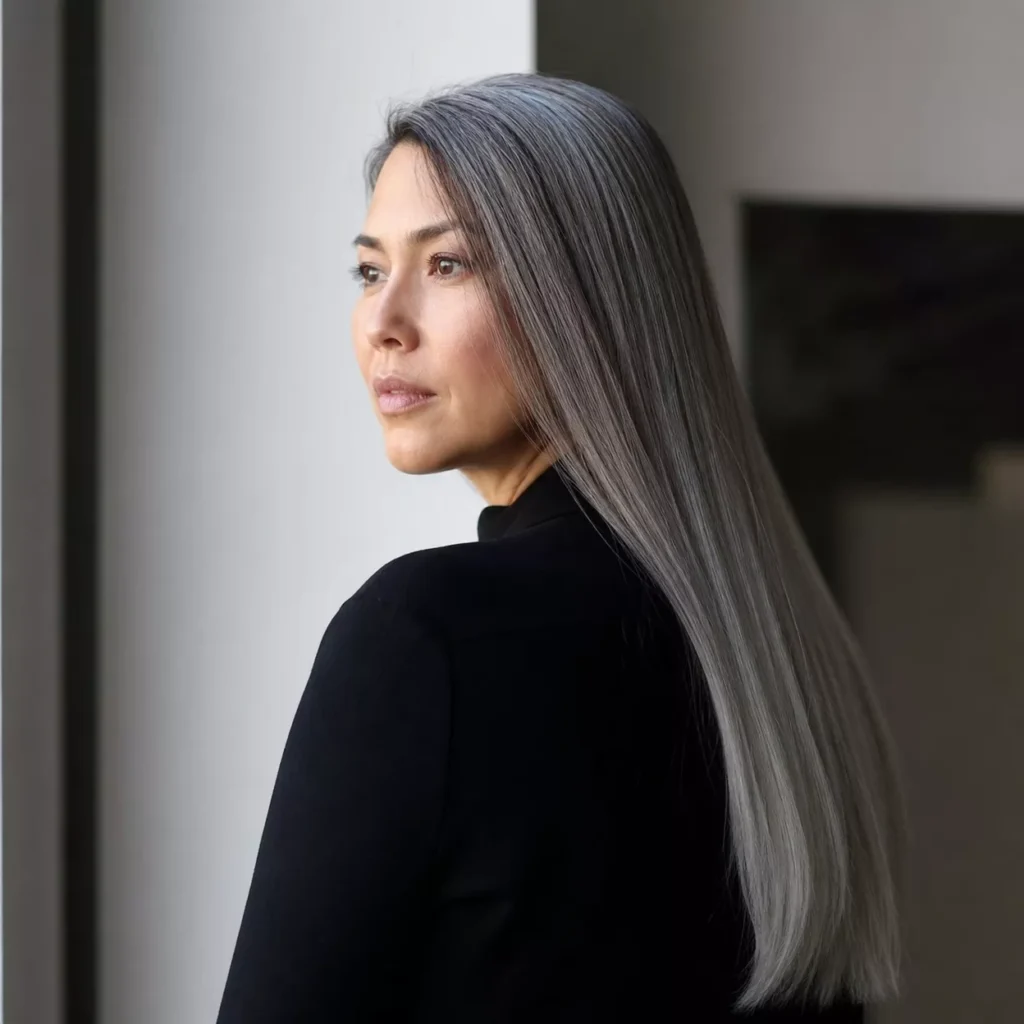
Smoothed straight, long gray reads editorial and modern, and the flat surface shows off every tonal shift from root to end. It is a striking look on straight or easily smoothed hair.
Two honest caveats. First, gray can be coarse, so getting it truly sleek often means a flat iron, and heat on already-dry gray is a fast track to breakage. Always use a heat protectant and keep the iron moderate. Second, sleek styles hide nothing: dry or damaged ends show immediately, so this look demands healthy hair to pull off.
Balayage Through the Length
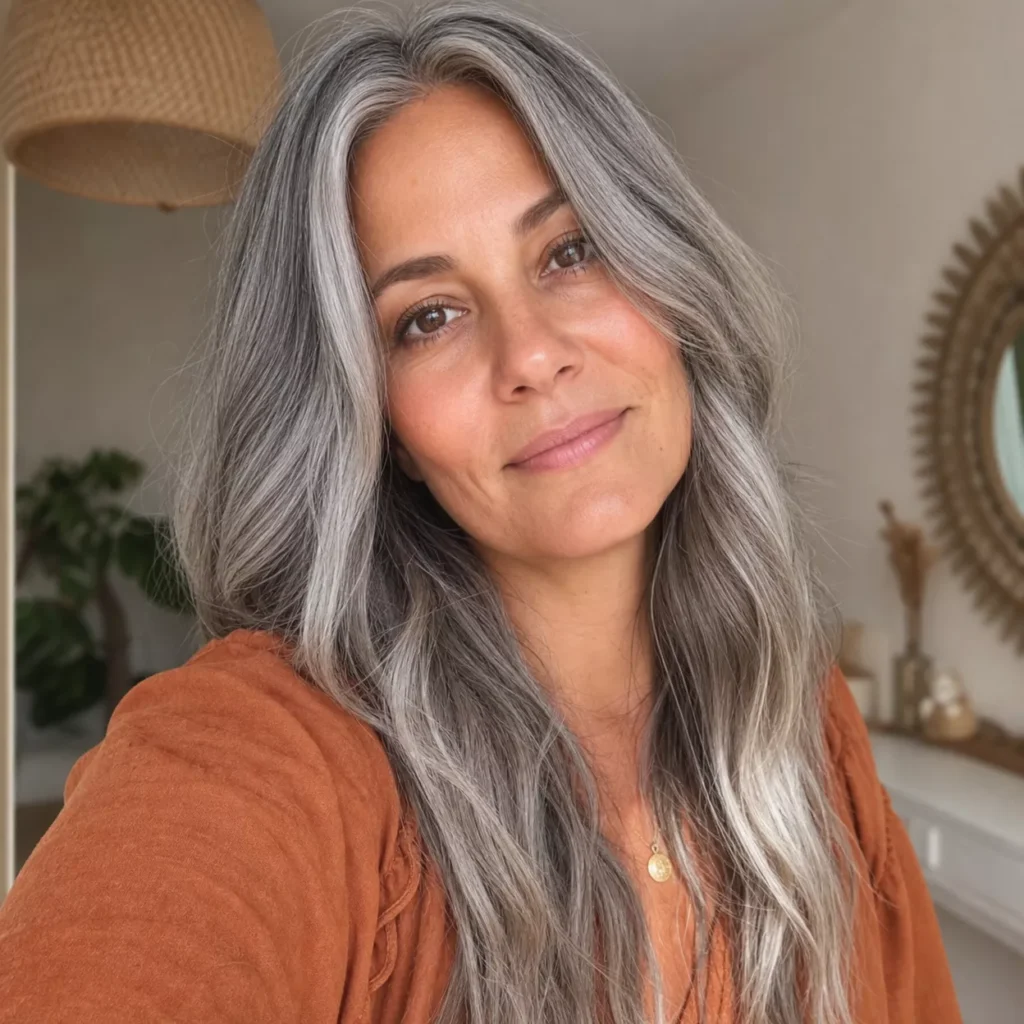
Balayage paints soft, hand-placed lightness through the mid-lengths and ends, so gray reads layered instead of flat. It grows out with no harsh line, which is why it’s the most requested color technique in salons and a favorite for lower upkeep.
Set expectations on cost and time. Balayage tends to start around $150 on short hair but runs closer to $250 to $450 on long or thick hair, and it can take two to four hours in the chair. You’ll also likely need a toner or gloss between full sessions to keep it cool.
Long Bob With Layers
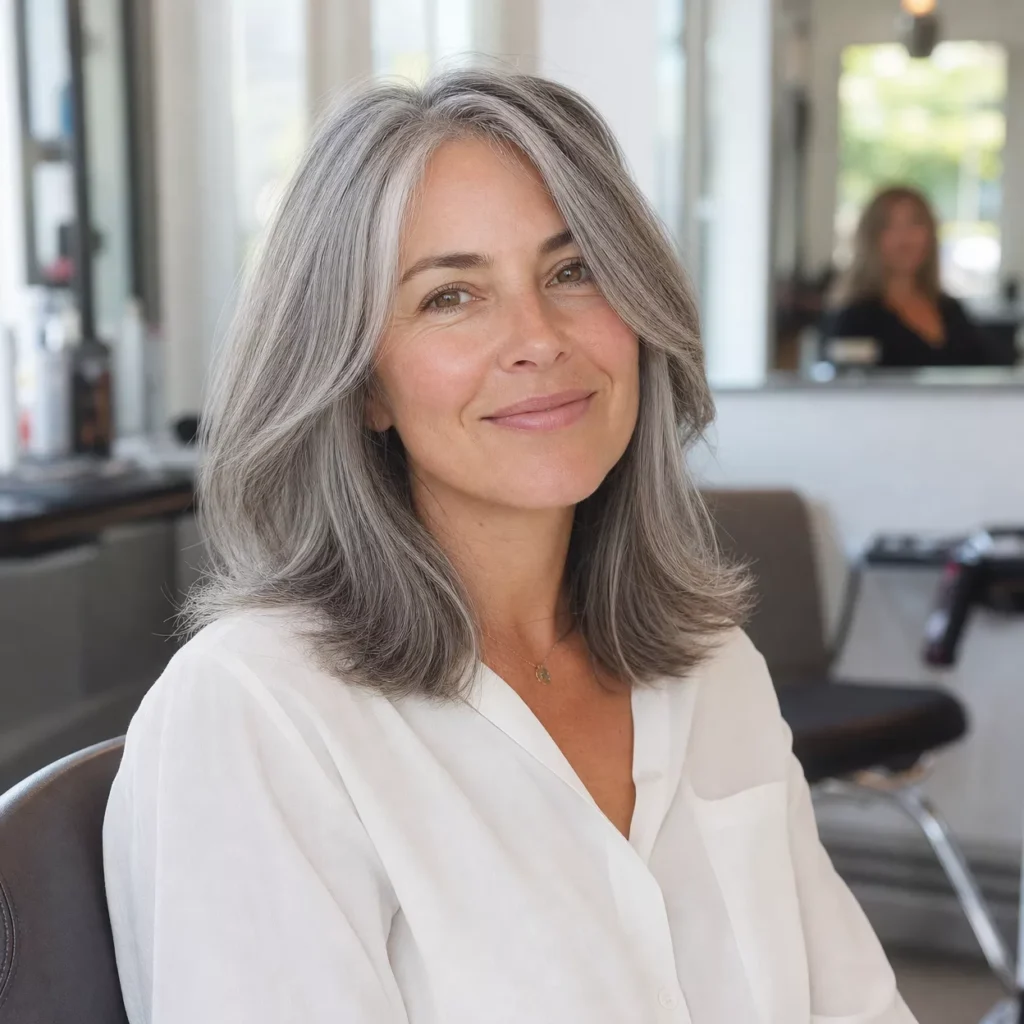
A collarbone-length lob with a few layers is the most manageable long-ish gray cut here. It keeps enough length to feel long while cutting daily upkeep, and the layers add shape that flatters most textures. It’s a common landing spot for people transitioning off dye, because shorter length reaches fully natural gray sooner.
If you’re truly attached to long length, this isn’t your cut. But if you’re on the fence, it’s the safest, easiest option on the list.
Side-Swept Bangs
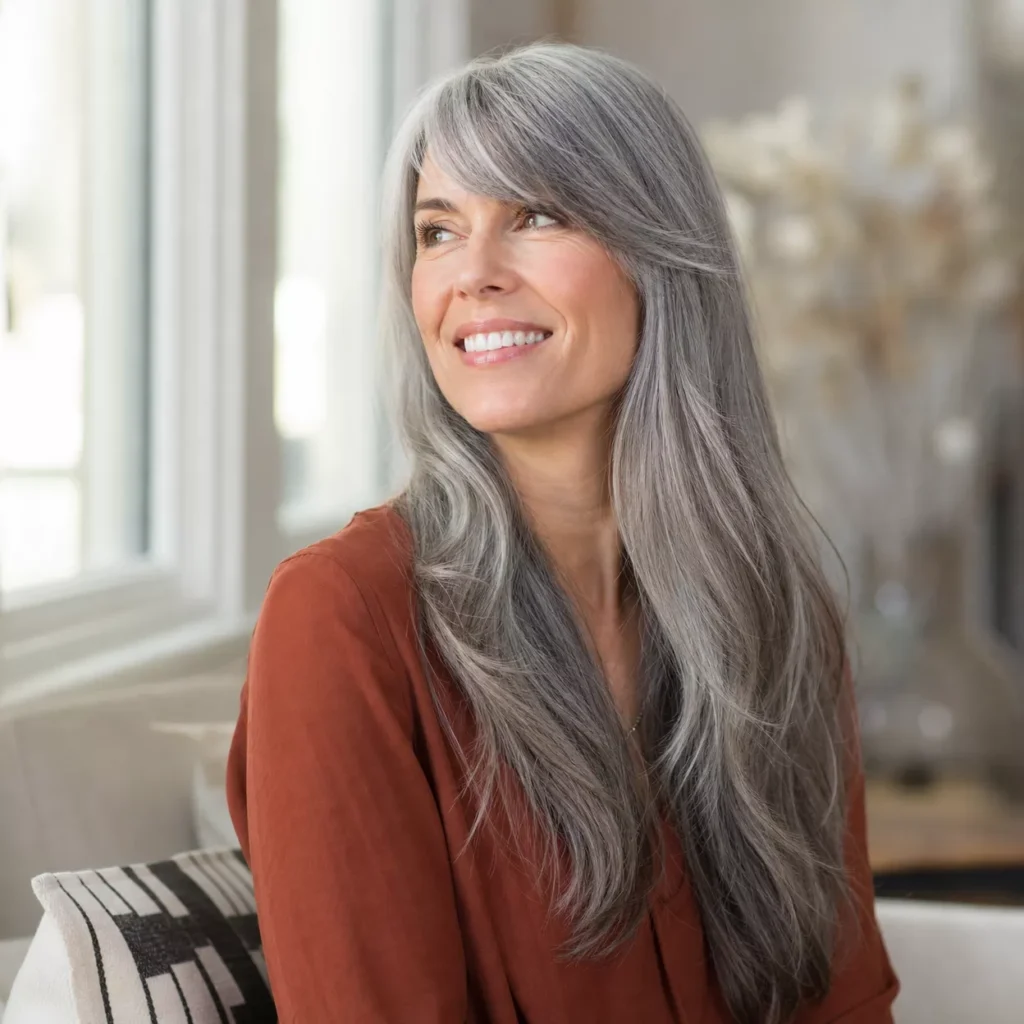
A soft diagonal sweep across the forehead frames the face and adds a little width at the top, which can flatter longer face shapes in particular. It’s less commitment than a blunt fringe and grows out easily into face-framing layers.
A note on toning, not a rule: If your gray starts looking yellow or brassy, a purple shampoo can help, but you may not need one at all. It’s widely recommended only about once a week on gray, and if you only wash weekly, once a month may be enough. Start with one wash a week, then adjust based on what you see in the mirror. Overuse backfires: leaving it on too long, especially on fine, light, or porous hair, can leave a lavender or gray tint. Always follow with conditioner, since these formulas can be drying.
Loose Waves With a Center Part
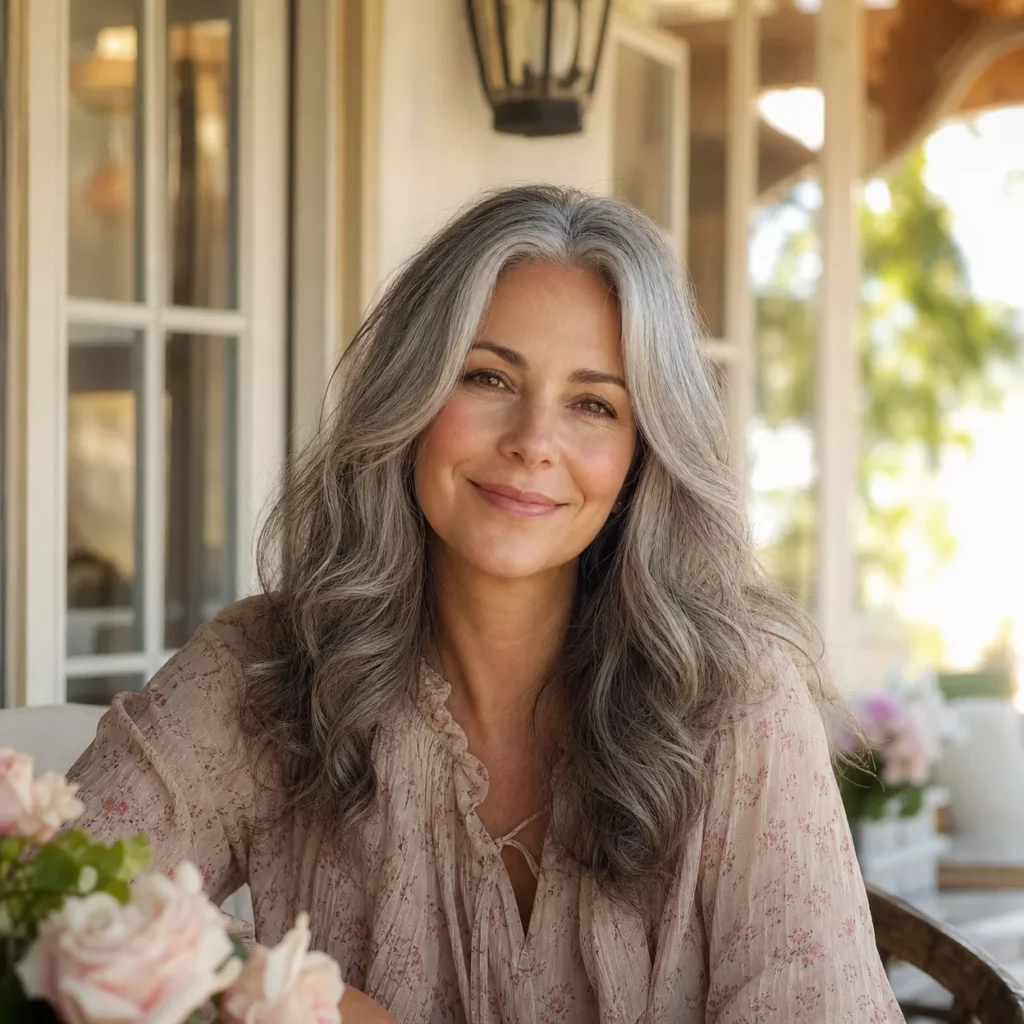
A center part with soft waves gives a balanced, symmetrical look that suits a wide range of face shapes. The part draws the eye to the middle of the face and the waves build even volume on both sides.
A center part is least forgiving on very round or very long faces, where it can emphasize the shape rather than balance it. A slightly off-center part is an easy fix if that’s you.
Curtain Bangs With Balayage
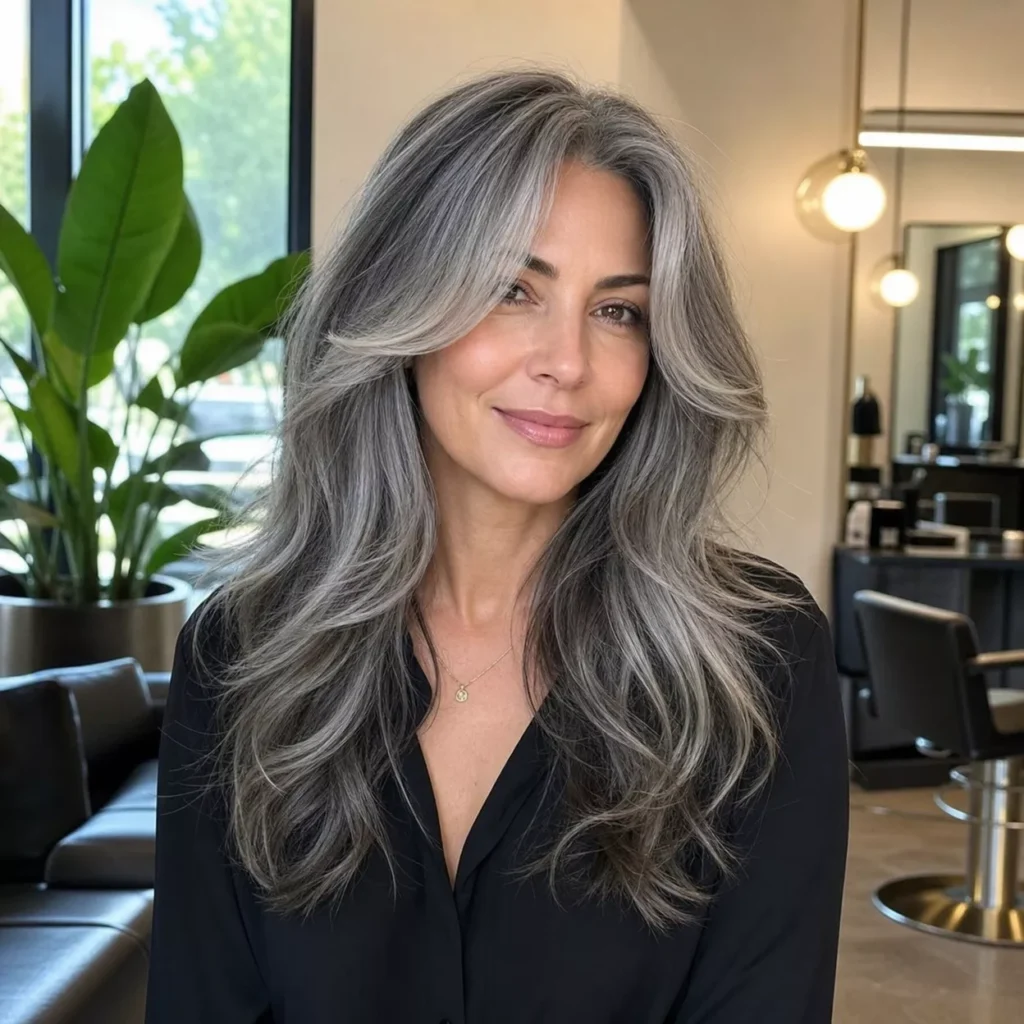
Combine the two and you get a cut-and-color package that looks expensively considered: framed at the face, dimensional through the layers. It’s a genuine investment of both time and money, so it makes most sense if you’re already committed to coloring and don’t mind the upkeep of both bangs and toner.
Natural Salt and Pepper

Left alone, a mix of dark and light strands creates dimension no colorist can perfectly fake. If your gray is coming in as true salt and pepper, the most striking move is often to do nothing but keep it healthy. Grow it, trim the ends, and let the contrast speak.
The main enemy here is dryness and yellowing at the white sections, so a moisturizing routine matters more than any styling.
A Loose Updo
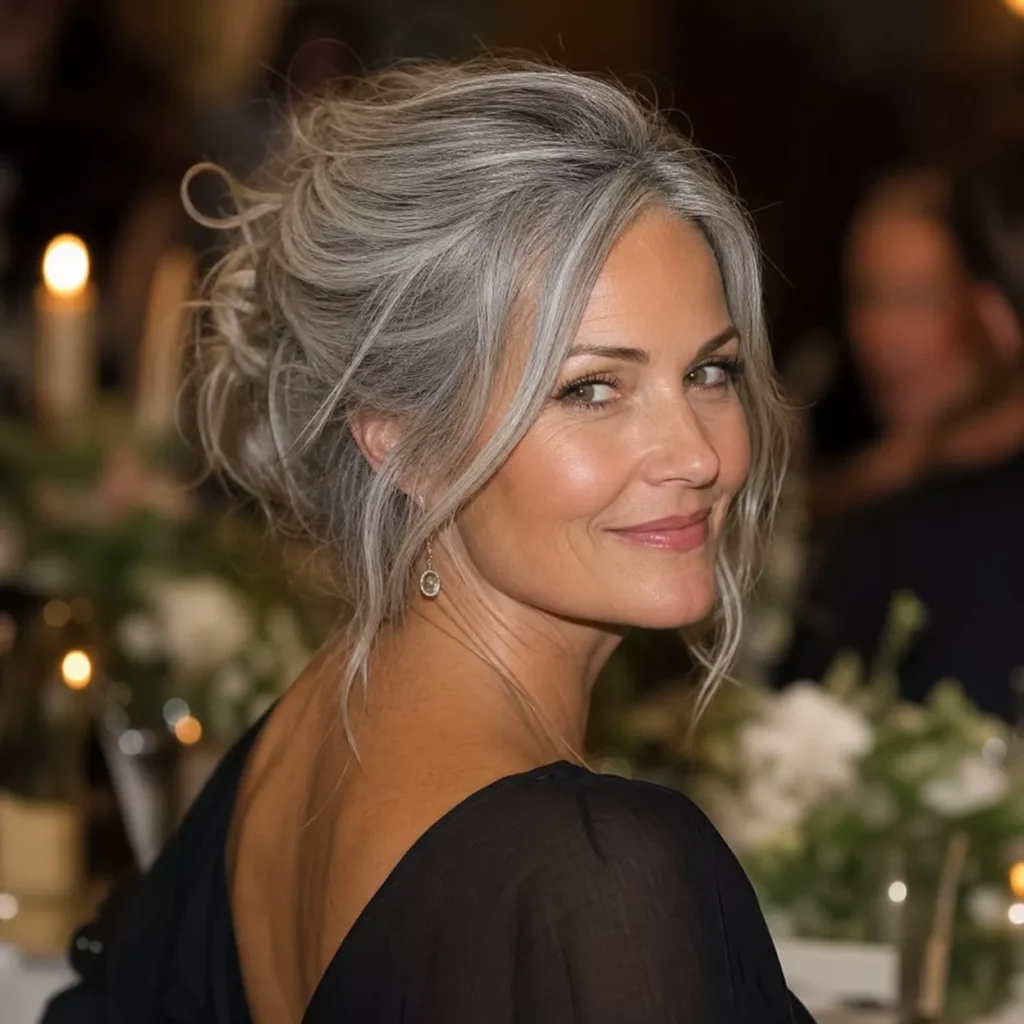
For events, a soft updo pinned low with a few face-framing pieces left out shows the gray tones well and photographs beautifully. It suits most hair, though very layered cuts can shed pieces, so bring extra pins. This is an occasion style, not a daily one.
Braids
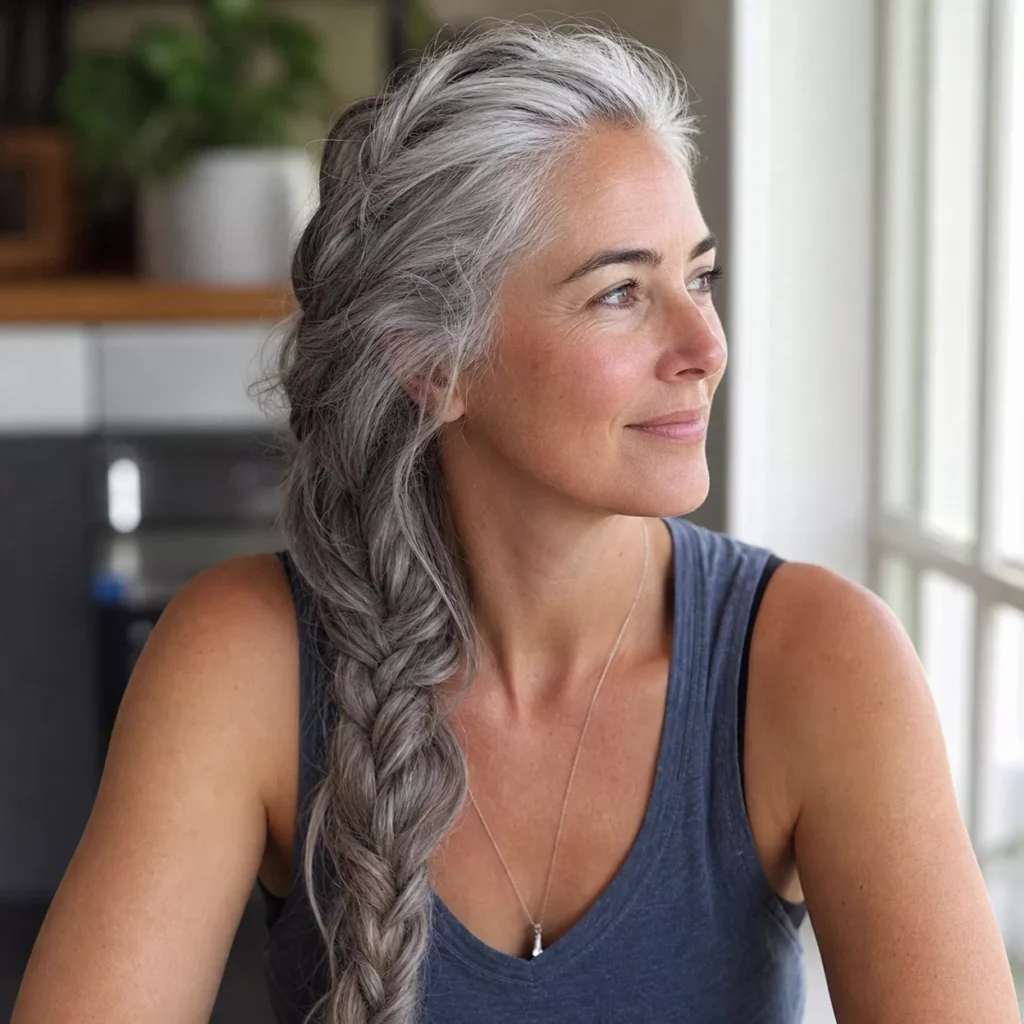
Braids add texture and keep length off the face, and silver tones catch light through each woven section. A simple French braid, a loose fishtail, or two relaxed Dutch braids all work. This is a styling choice rather than a cut, so it costs nothing to try. Coarser gray can be harder to keep smooth in a braid, so a little cream or oil helps tame flyaways.
A Root Shadow
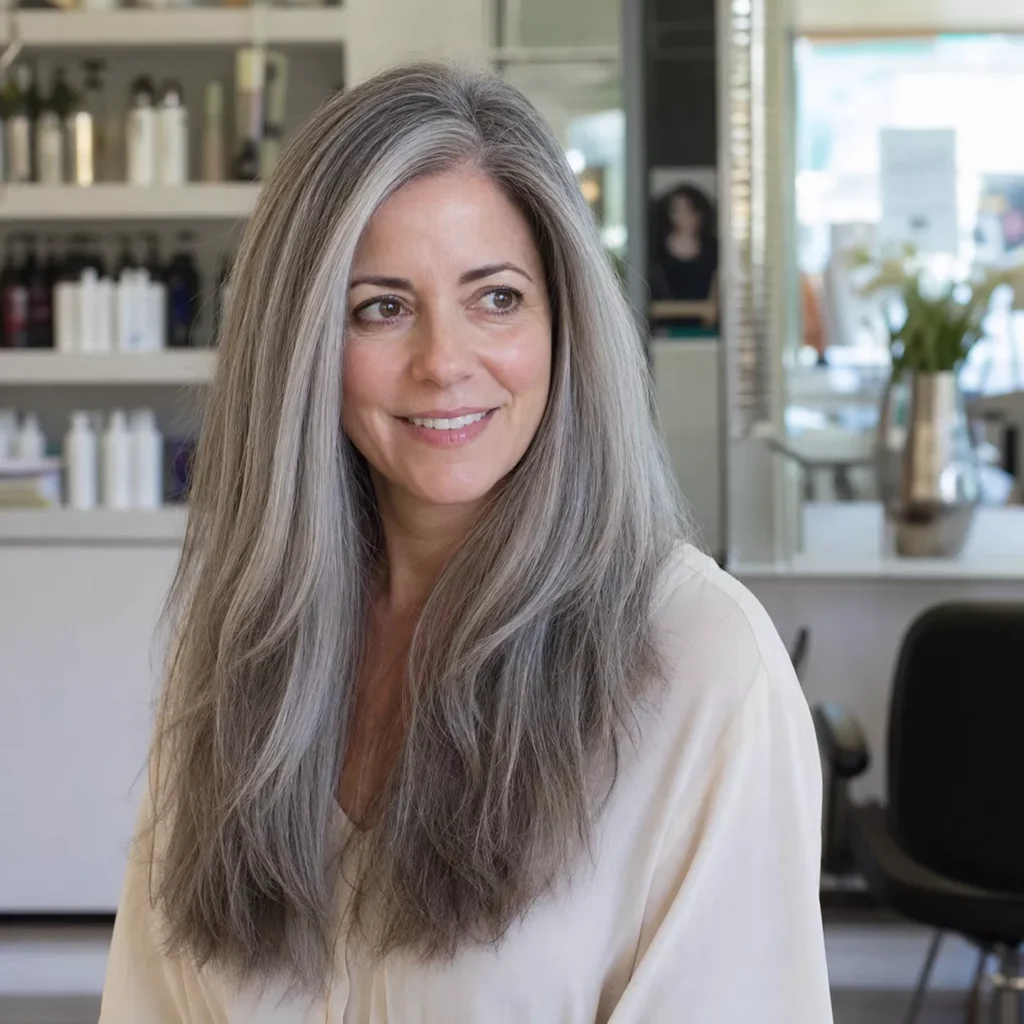
A root shadow adds soft depth at the roots and blurs the line between your natural regrowth and lighter gray. It’s one of the best tools for making a transition look intentional from day one, and it’s low upkeep because there’s no sharp regrowth to chase.
If your goal is fully natural, undyed gray, know that a root shadow is still color, so it delays reaching your true tone. It’s a bridge, not a destination.
Long Layers, Left to Flow
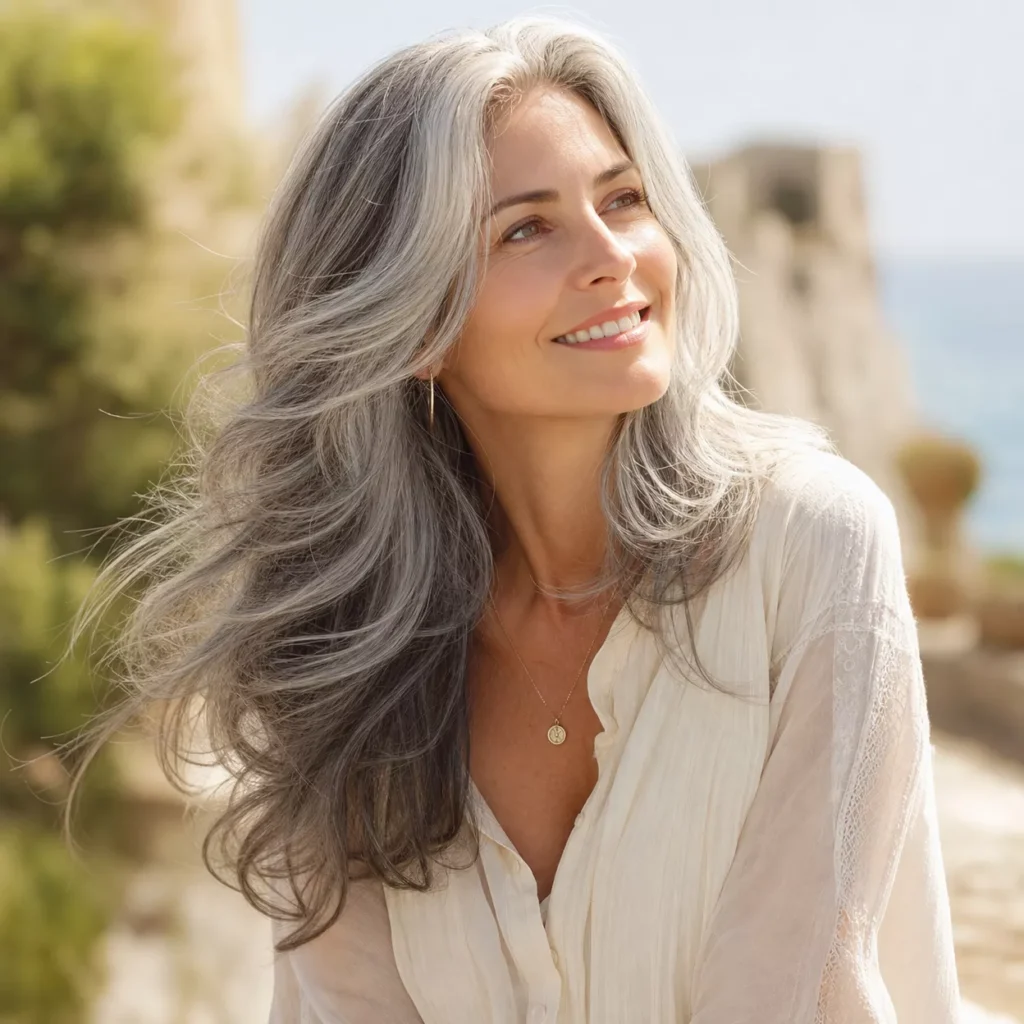
On thick hair that feels heavy, long layers remove weight through the mid-lengths so the gray moves and shines instead of sitting like a curtain. The payoff is soft, cascading movement.
On fine hair, aggressive layering can thin the ends and make the hair look sparse rather than light. If your hair is fine, ask for conservative, long layers rather than heavy internal removal.
A Half-Up Style
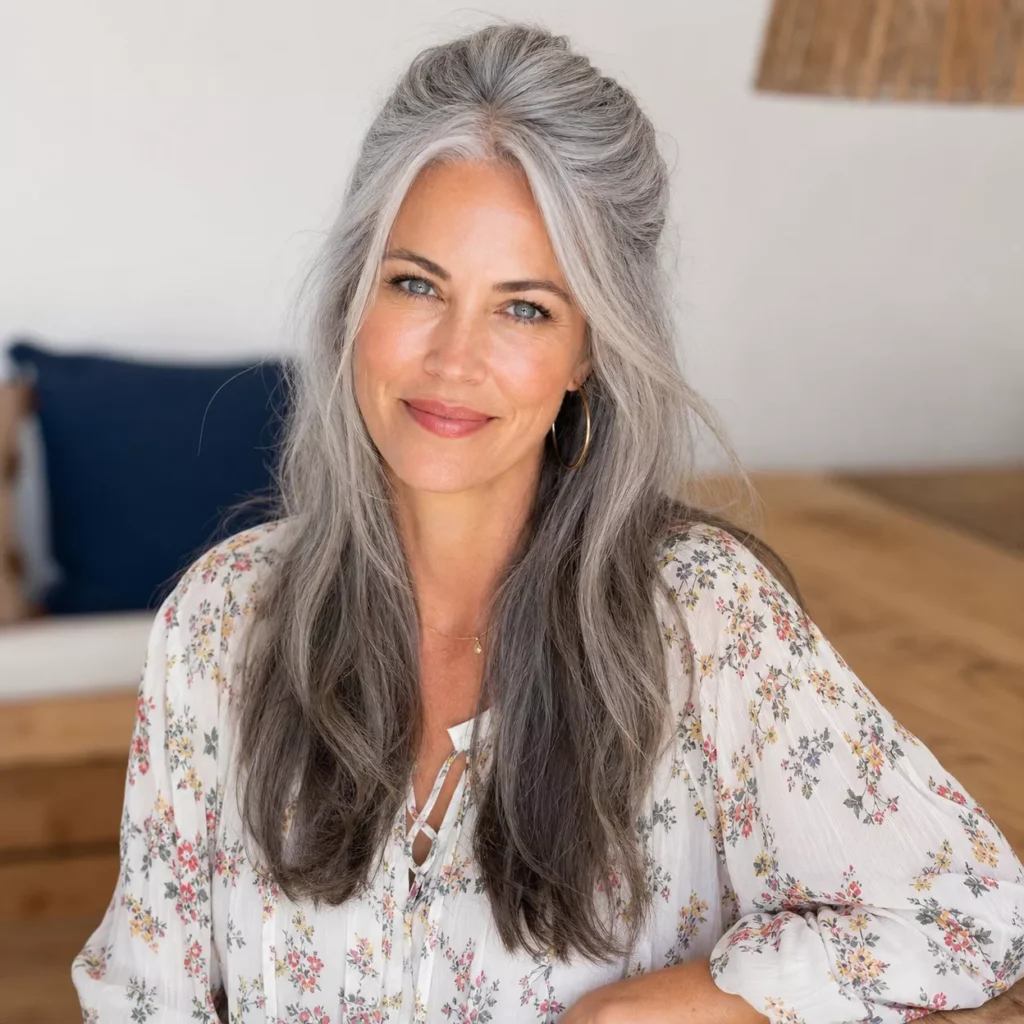
The quickest polish on this list: gather the top loosely, leave the rest down, done in a couple of minutes. It works across textures and occasions and asks nothing of your cut. There’s no real downside, which is why it’s a reliable everyday fallback.
Icy Blonde Highlights
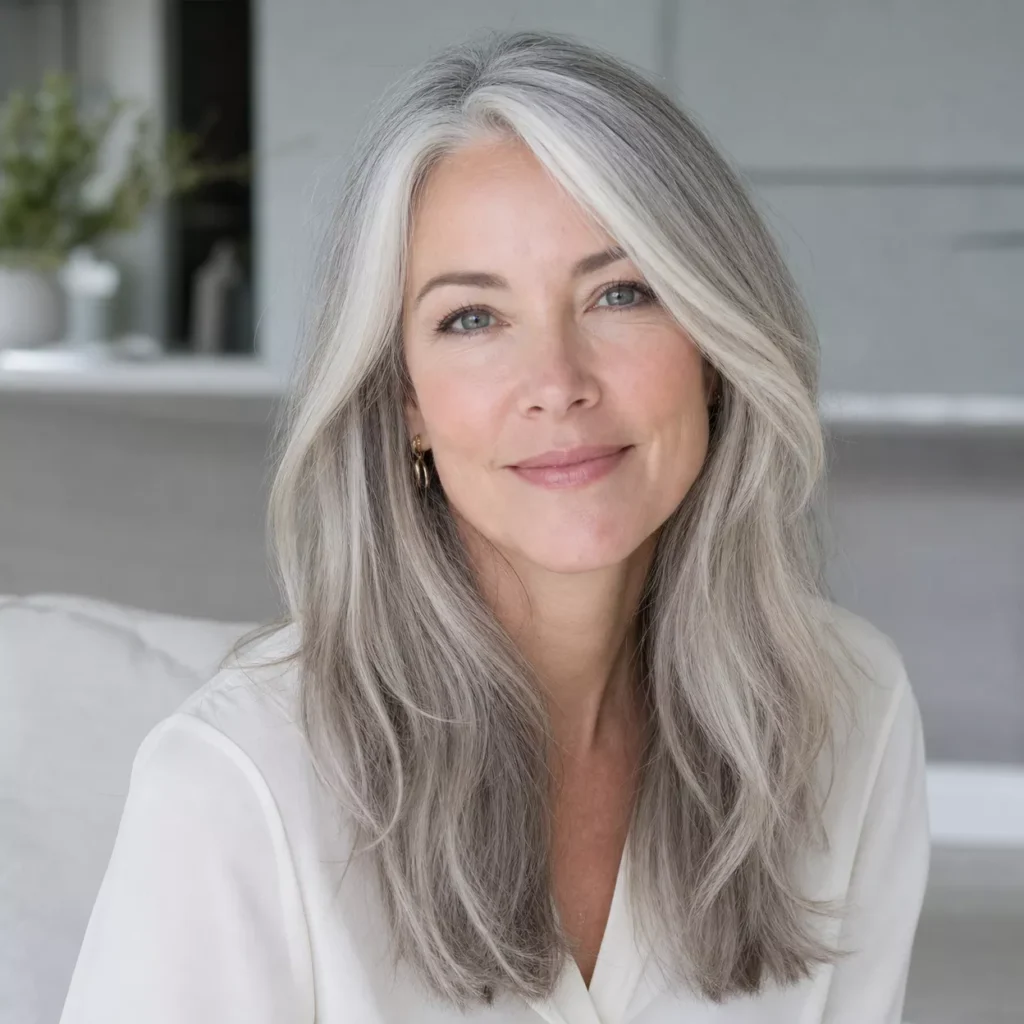
Near-white highlights blend into your lighter gray strands and push the whole head toward a cool, platinum-leaning finish. The effect is bright and modern.
This is the highest-upkeep color choice here. Icy tones fade warm quickly, so you’re signing up for regular toning and careful at-home care, and the lightening itself can stress already-porous gray. Have the health-of-your-hair conversation with your colorist first.
Wavy Length With Curtain Bangs
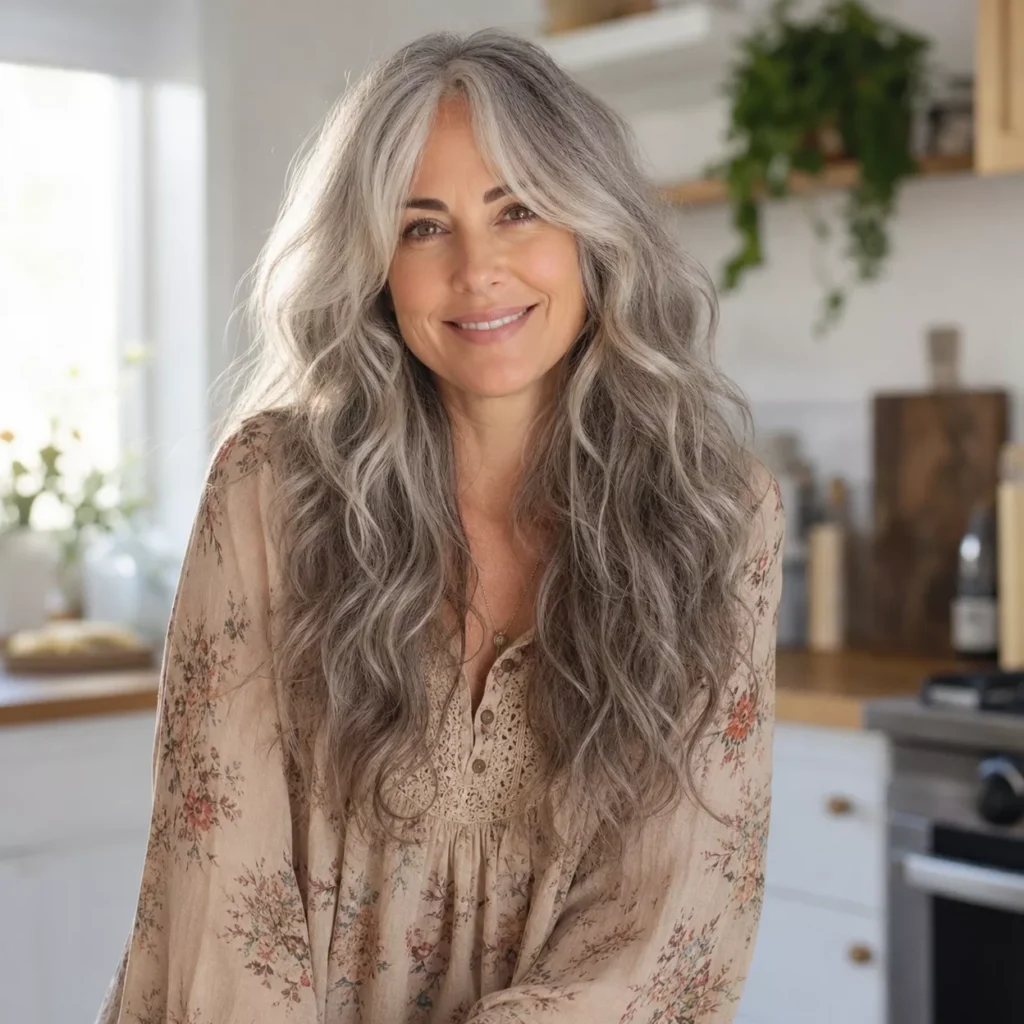
If your hair has natural wave, this pairs the softness of curtain bangs with an easy, textured length. Scrunch curl cream through damp hair and air-dry. Like the other wave looks, it’s texture-dependent and fights back on straight hair, and like the other bang looks, it needs regular trims at the fringe.
Long Gray After 60
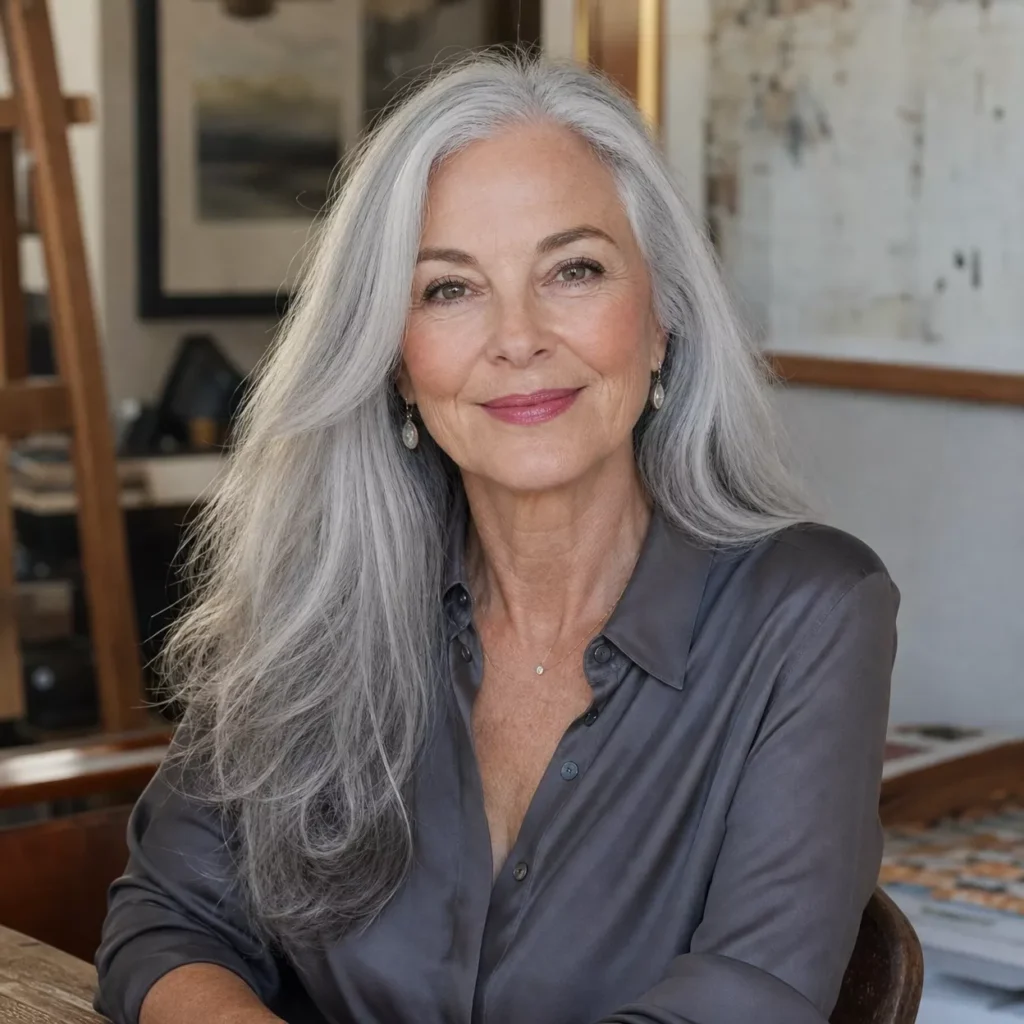
There’s no age at which long hair stops being an option, and plenty of people wear it long and gray with real confidence past 60. The deciding factor isn’t age, it’s condition. Gray that’s well conditioned, trimmed on schedule, and toned only when needed looks polished; gray that’s dry and frayed at the ends looks tired regardless of length.
If thinning is a concern, a collarbone lob or long layers can read fuller than very long, sparse length. It’s worth an honest look in the mirror rather than a rule.
Textured, Lived-In Layers
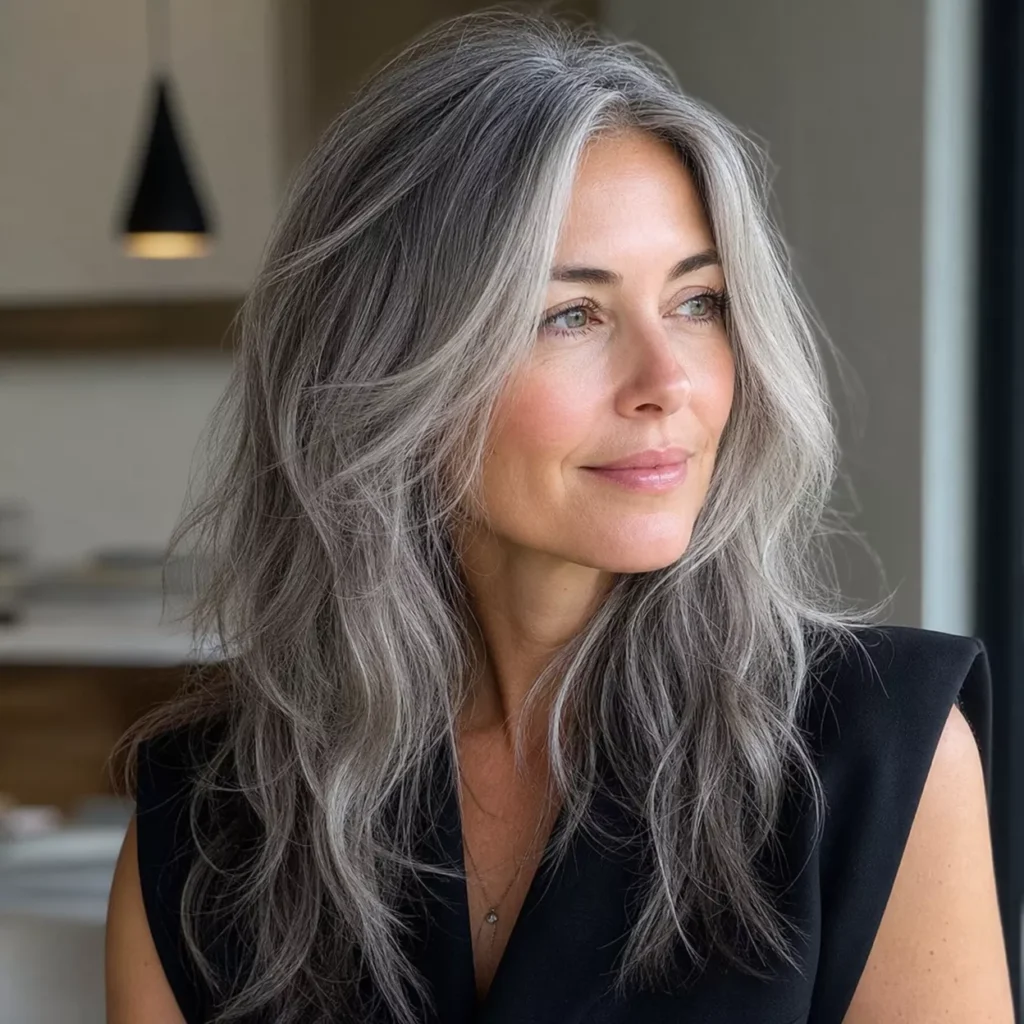
Choppy, piece-y layers with a lived-in finish keep long gray feeling current instead of heavy. A light texturizing spray on dry hair, tousled with fingers, gives grip and separation. It’s forgiving and low-effort, and it flatters fine-to-medium hair that needs the illusion of thickness. Very fine hair should go easy on the product, since too much spray can look gritty rather than textured.
Which One Actually Suits You?
Treat this as a starting point. Texture, density, and personal taste matter as much as any guideline, and a good stylist will adapt any of these to your head.
By hair type. Fine hair usually looks fuller with long layers, a blowout, or textured, piece-y layers. Thick hair benefits from long layers and waves that remove weight. Naturally wavy hair is happiest in beach waves, loose waves, or curtain-bang looks that work with the texture. Straight hair shows off sleek finishes and face-framing highlights. Curly hair does best in a long, layered shape styled with curl-specific products rather than forced smooth.
By face shape. Round faces tend to like longer face-framing layers and side-swept bangs for a bit of length and structure. Oval faces can wear most of the list. Square faces soften with waves plus curtain or side-swept bangs. Heart shapes balance well with curtain bangs and layers. Longer faces suit waves and bangs that add width at the sides rather than more length on top.
Understanding the Color Terms
If the color menu is confusing, here’s the short version.
| Technique | What it does | Rough upkeep |
|---|---|---|
| Balayage | Hand-painted, gradual lightness through length | Every ten to fourteen weeks |
| Root shadow | Softens the root-to-length transition | Low, grows out cleanly |
| Face-framing highlights | Brightens the pieces around the face | Every eight to twelve weeks |
| Icy highlights | Adds bright, cool contrast throughout | High, needs frequent toning |
One thing worth repeating: coarse, white gray can resist lightener, so any of these may behave differently on gray than on pigmented hair. A consultation is not a formality here, it’s how you avoid surprises.
Keeping Long Gray Hair Healthy
Gray tends to run drier and more porous than pigmented hair, so the routine leans toward moisture and gentleness.
Cleanse gently. Look for a sulfate-free shampoo made for gray or color-treated hair. Harsh cleansers strip the natural oils gray can’t spare.
Condition, then condition more. A weekly deep-conditioning mask is a reasonable baseline for long gray, more if your ends feel rough. On product choice, avoid heavy oils and butters on fine hair, since they flatten it; a lightweight serum or a drop of oil on the ends only is usually enough.
Respect heat. Always use a heat protectant, keep tools at a moderate temperature, and air-dry when you can. Dry gray plus high heat is where breakage starts.
Mind sun and water. UV and hard water both push gray toward yellow and dry it out. A hat in strong sun and an occasional clarifying or chelating wash help more than piling on purple shampoo.
Trim on a rhythm. Regular trims are what keep long ends from looking frayed. Many stylists suggest roughly every eight to twelve weeks for long hair, adjusted to how fast yours splits.
Tone only if you need to. Covered above: start at once a week at most, follow the product’s timing, and stop if the tone goes dull or violet. Not everyone with gray needs a purple product at all.
Growing Out Your Gray: What to Expect
Transitioning off dye takes patience, but a few moves make it smoother.
You’ll see a demarcation line where natural gray meets colored hair. That’s normal and temporary. To soften it, colorists use highlights, lowlights, or a root shadow so the grow-out reads gradual instead of striped.
There are really two routes. Cutting shorter over time removes colored ends faster, so you reach fully natural gray sooner, which is why so many transitioners land on a lob. Blending with color lets you keep your length while the line grows down, at the cost of ongoing salon visits. Neither is wrong; it depends on whether length or speed matters more to you.
Timeline-wise, a full transition often takes many months to a couple of years depending on your starting length and how fast your hair grows, since hair averages roughly half an inch a month. Keep it conditioned and toned as needed through the awkward middle, and lean on a stylist. This is the stage where professional blending earns its cost.
What to Say at the Salon
Vague requests get vague results. Specifics help.
Instead of “I want long gray hair,” try: “I want to keep my length, but add long layers that create movement without thinning the ends.”
For bangs: “Soft curtain bangs that blend into face-framing layers, not a short blunt fringe.”
For color: “I want to enhance my natural gray with soft dimension, not cover it. Can we talk about whether balayage or a root shadow makes more sense for my hair?”
And always, on gray: “How will lightener behave on my hair, and do you recommend a consultation or strand test first?”
What It Costs (US, 2026)
Most beauty guides skip pricing, which is exactly why it helps to have it. Treat these as planning baselines, not quotes. Prices swing with region, salon tier, and your hair’s length and thickness, so the same service can cost twice as much across town or across the country.
| Service | Mid-Market Salon | Premium / Metro Salon |
|---|---|---|
| Women’s cut | $55 – $90 | $150+ |
| Root touch-up | $50 – $100 | $100+ |
| Partial highlights | $100 – $200 | $200+ |
| Full highlights | $150 – $300 | $300+ |
| Balayage | $150 – $250 | $350 – $450+ |
| Toner / gloss (between color visits) | $30 – $60 | $60+ |
Two things to budget for on top of these:
- Length and thickness surcharge. Long or thick hair usually adds $15 to $40 on a cut or blowout, and $50 to $100 or more on color, because it takes more product and chair time.
- Toning between visits. On balayage and highlights, a toning step is usually needed to hold the cool tone, and it’s often priced separately rather than baked into the color service.
A quick way to think about value: balayage costs more up front than highlights, but because it grows out softly with no harsh line, you visit the salon less often, so the yearly cost can actually work out lower.
FAQ
Is long gray hair flattering after 50 or 60?
It can be. Condition and cut matter far more than age. Healthy, well-shaped gray looks polished at any age; dry, frayed ends don’t, regardless of length.
How do I keep long gray hair from looking dull?
Prioritize moisture and shine: a weekly deep conditioner, a light serum on the ends, gentle sulfate-free cleansing, and toning only if it turns brassy. Regular trims keep the ends looking fresh.
Do I actually need purple shampoo?
Not necessarily. It helps when gray yellows or goes brassy, but plenty of people don’t need it. If you do, once a week is a common starting point for gray, and overuse can leave a purple or dull cast.
What makes fine gray hair look fuller?
Long layers, a rounded blowout, and textured, piece-y layers all add the appearance of density. Avoid heavy oils that flatten fine hair.
Is long gray hair harder to maintain than colored hair?
It’s often drier and coarser, so it needs more moisture, but many layered and wavy looks are otherwise low-effort. Difficulty depends mostly on the style you pick.
How often should long gray hair be trimmed?
Roughly every eight to twelve weeks suits most long hair, adjusted to how quickly your ends split.
Can you add highlights to naturally gray hair?
Yes, though coarse white strands can resist lightener, so results vary and may need a second pass. A consultation or strand test first is smart.
What’s the best way to grow dyed hair into natural gray?
Either cut shorter over time to reach natural gray faster, or blend with highlights, lowlights, or a root shadow to keep your length while it grows in. A stylist can tell you which fits your hair and timeline.
Before You Book
Choosing comes down to a few honest questions. What’s your natural texture, and will this style work with it or against it? How much upkeep will you actually do, not just intend to? Does face framing matter to you? Is your hair healthy enough for the color or heat the look needs?
Answer those and the shortlist gets small fast. Then save two or three photos of your favorites, note your texture and how much time you’ll realistically spend styling, and bring both to a consultation. That short bit of prep is usually the difference between a look you like and one you keep coming back to.